
2026 BRIEF
Full Reclaim
For 2026, Antepavilion optimistically looks forward to a post-AI era in which craftsmanship finds a bigger place in the skill set of architects and re-use of materials becomes routine as they identify more with artists and craftsmen - leaving the drudgery of producing perfunctory buildings to the machines. This year the competition’s long-standing encouragement of the use of reclaimed and recycled materials becomes an imperative.
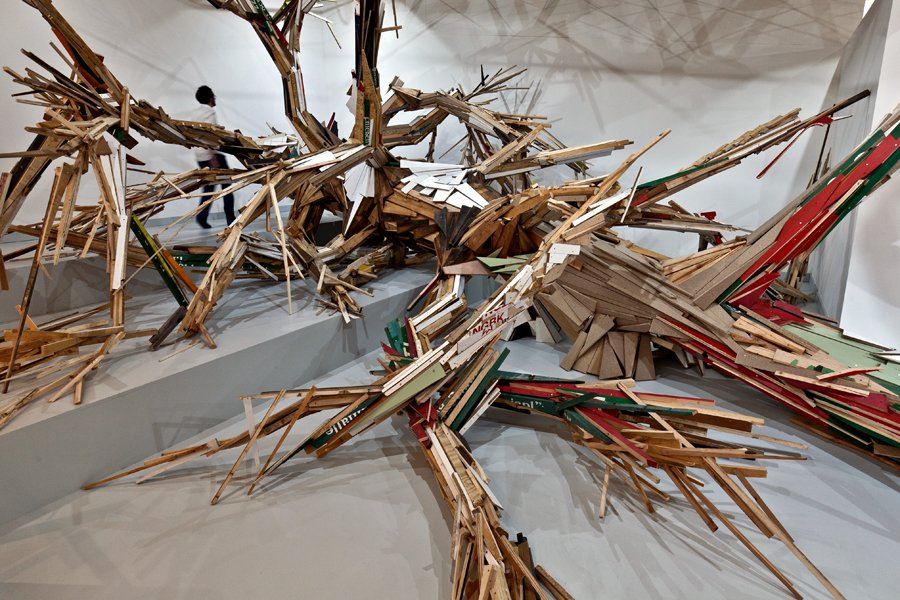
Upgrading by Folke Köbberling & Martin Kaltwasser, 2012. A sculpture of a tree made from recycled materials, which asks how much real timber is used in today's wood products.
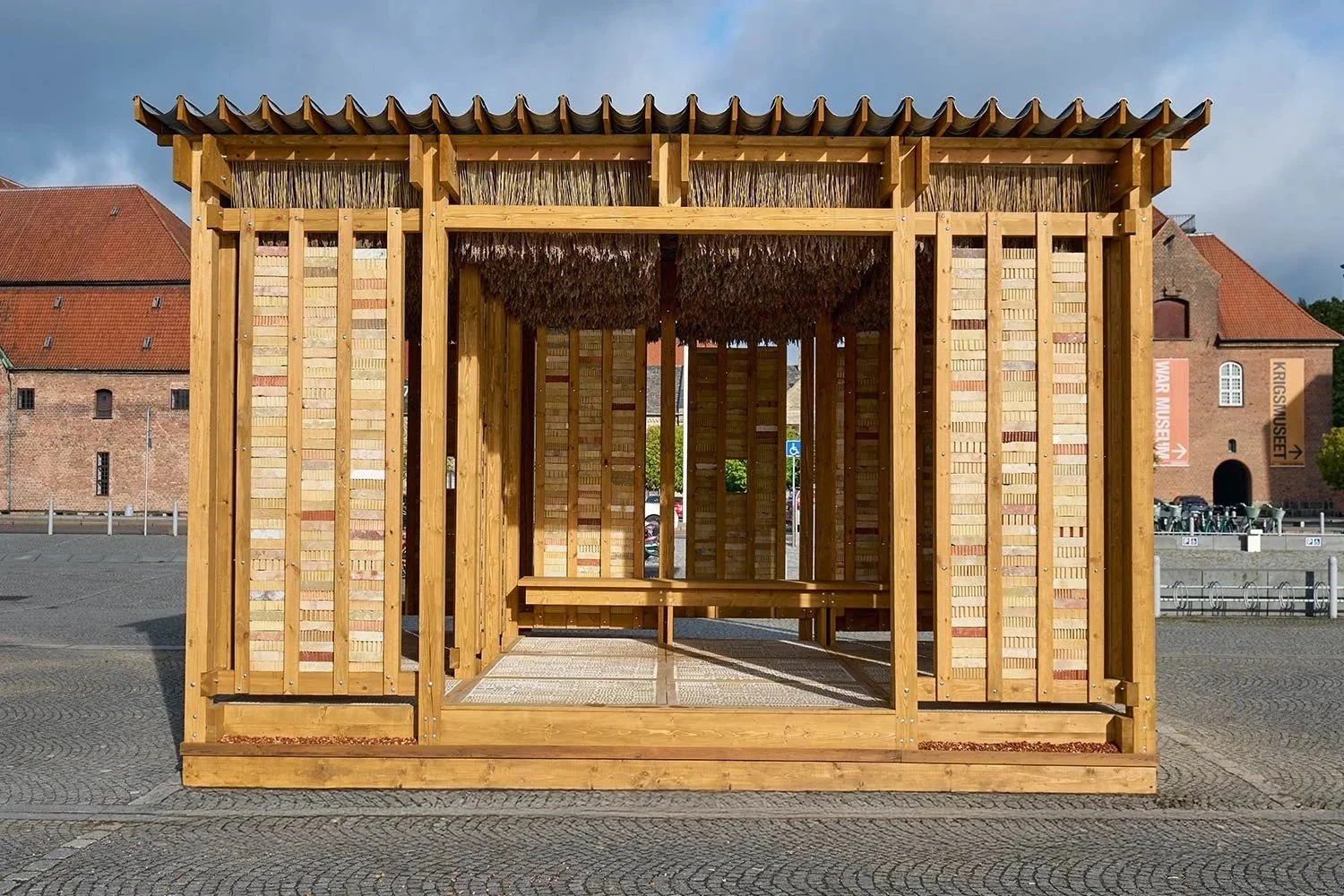
Upside Down, Inside Out by studio Slaatto Morsbøl, 2025. Designed as a demonstration of the value of salvaging, processing and repurposing discarded materials and slowing down in construction.
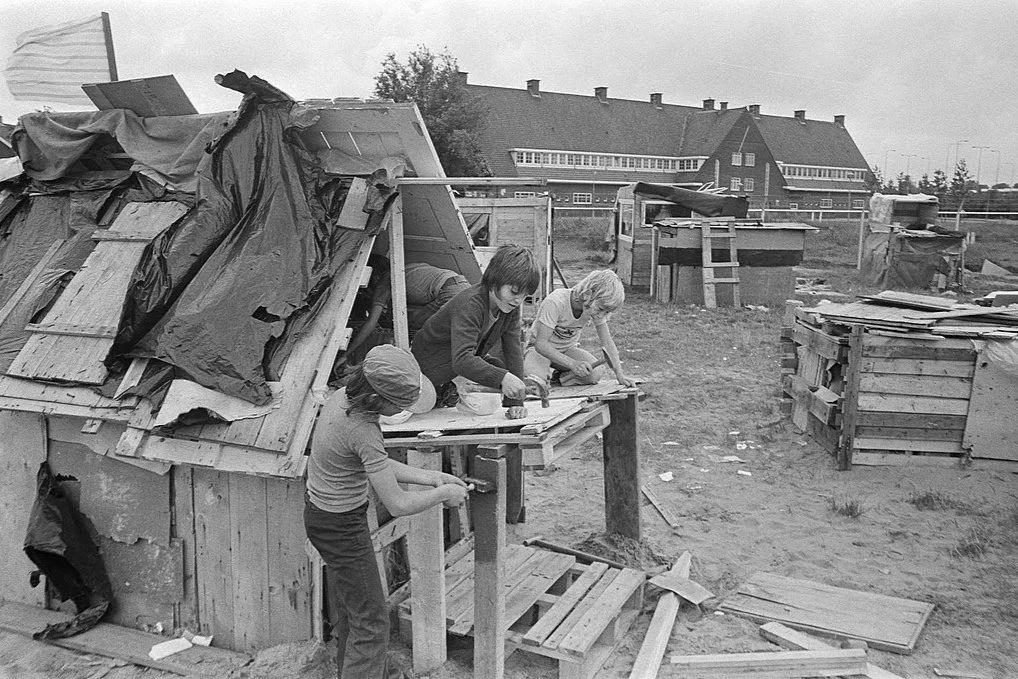
Amsterdam, 1974. In the ruins of post war Europe, ‘Junk Playgrounds’ sprang up in empty lots where, out of the junk lying around, children would construct, deconstruct and reconstruct their own playgrounds.
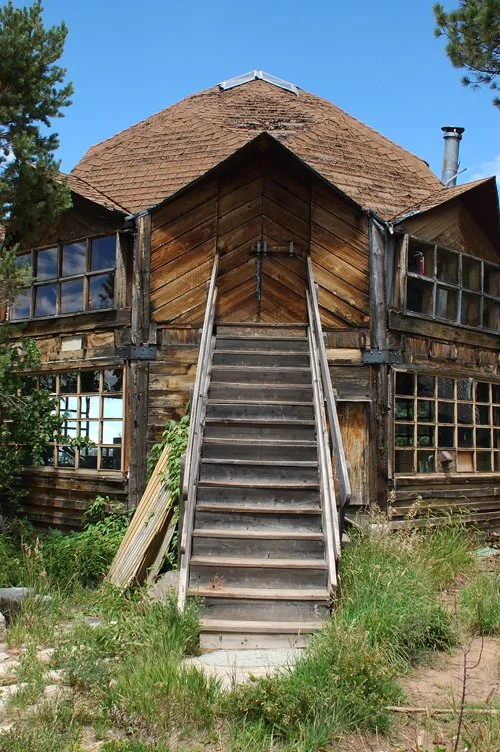
Lama Foundation, New Mexico. Built in the 60s/70s, then following a fire rebuilt in the 90s, the Lama Foundation emphasised DIY builds from natural materials.
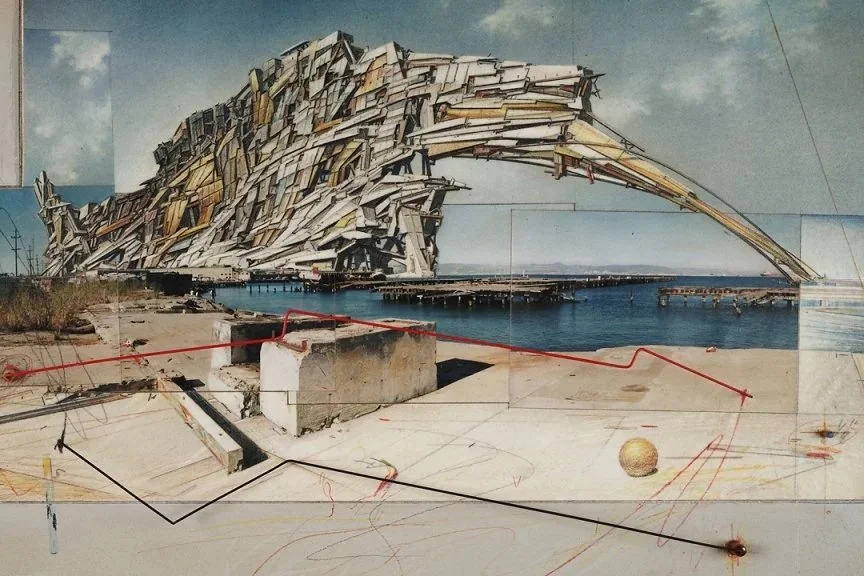
Quake City, Lebbeus Wood, 1995. In the mid 90s Woods imagined the architecture that would emerge after the ‘Big One’, a magnitude 8+ earthquake. The structures he envisioned were constructed, transformed or even completed by the earthquakes themselves.
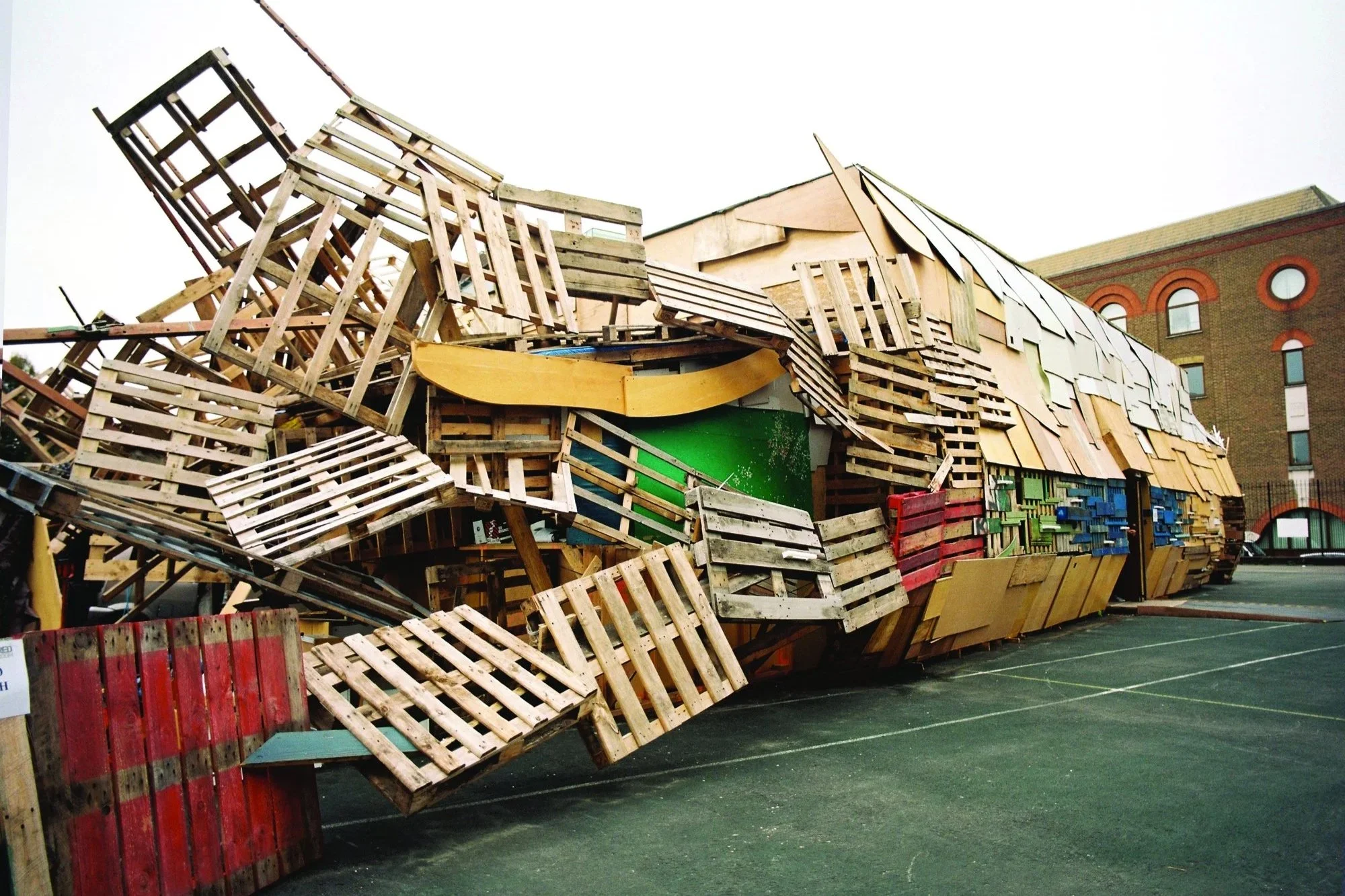
Jellyfish Theatre, by Folke Köbberling & Martin Kaltwasser, 2010. A 120 person theatre built by volunteers entirely out of reclaimed materials.
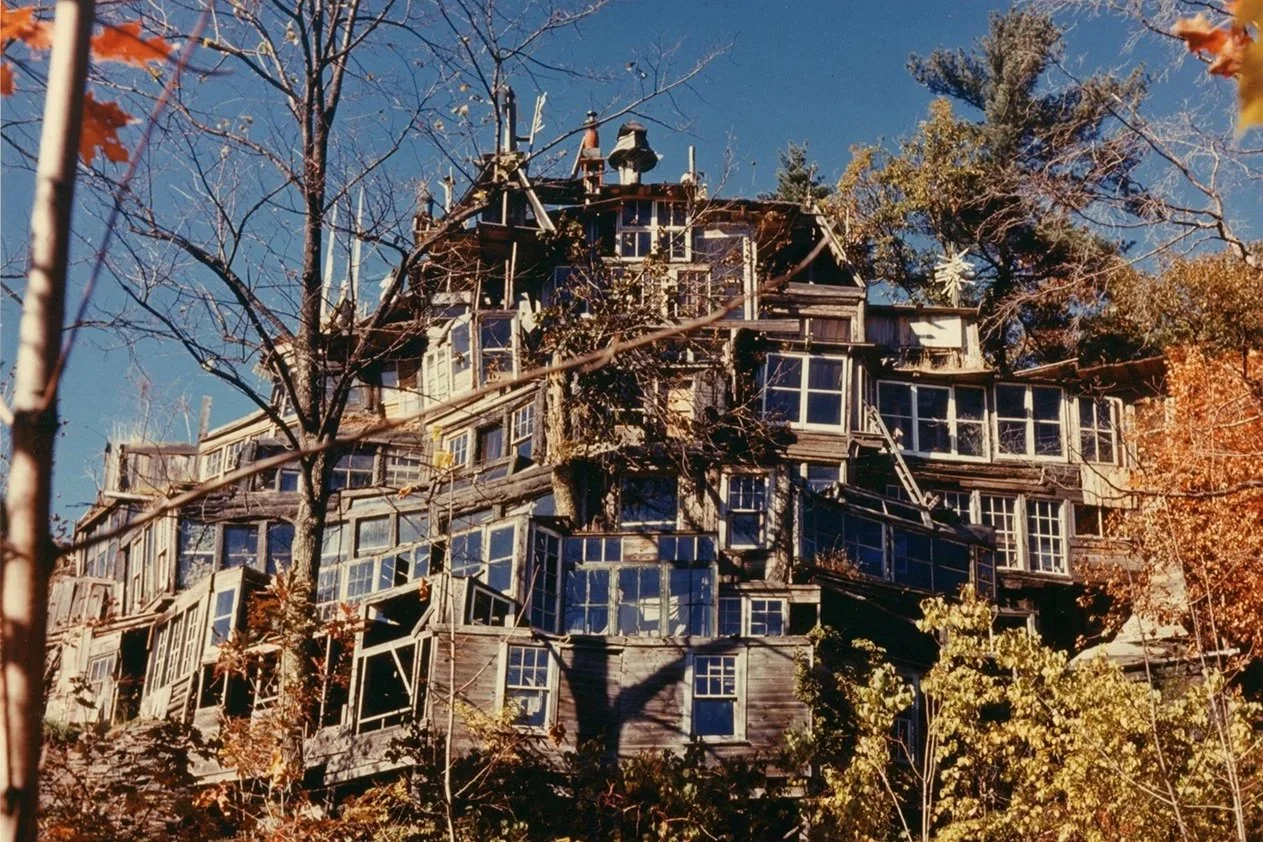
House of Mirrors, by Clarence Schmidt, Woodstock, 1940. A 7 storey, 35 room ramshackle home built by Schmidt largely out of salvaged materials
Open call
The Antepavilion competition is open to everyone; no qualifications are required. We make available some specialist skills, particularly metalworking and structural engineering support if necessary. But the overarching requirement is that entrants must be able to make and install their work essentially themselves.
Brief
Now in its tenth year, the Antepavilion competition takes stock of the passage of a decade: things haven’t got better. Overregulation proceeds apace and opportunities for public individual free expression in urban settings are increasingly few.
Antepavilion’s mission has always been to promote the place of grass-roots, self-build architecture and artistic free expression as a counterpoint to system-build, battery-farm architecture and building in cities. To defend its place as a career option for young architects: a place alongside craftsmen and artists. An alternative to the big architecture factories in which so many architects in Britain find themselves trapped.
But there are possible rays of hope in the coming changes to the labour market now being so confidently anticipated through the emergence of AI. There is no reason to think the swathes of middle-class occupations that seem set to be done better by machines will exclude factory architecture. So architects may yet be driven back to their historically closer connection with craftsmanship and hands-on construction to survive as a productive sector of the labour market.
History may turn out to be on Antepavilion’s side. This year’s brief is a vigorous nod to that possibility. For Antepavilion 2026 only reclaimed materials will be available to entrants to work with. For as long as the competition has been running the use of reclaimed materials has been encouraged. That encouragement has not been wholly disregarded by any of the winners. But neither has it been taken close to is logical conclusion: nothing new.
Antepavilion has access to a large array of materials, either reclaimed or surplus from other building projects. Many of these with the most obvious potential for creating a 2026 winner are listed and pictured below, but entrants will probably need to attend our open days to adequately understand the materials, their quantities and their assembly possibilities. Whilst use of the materials already available will be favoured entrants are also free to propose other reclaimed materials that Antepavilion would acquire for them.
The Full Reclaim brief will demand a high level of hands-on construction engagement from the winners, very likely including traditional craftsmanship skills: carpentry, masonry, metalworking, etc. The winning entry will ideally stand as an exemplar of the seamless fusion of the skills of construction and conception: a unified process more associated with the working methods of the sculptor than the architect. The installation may sit anywhere on the scale from functional, and even habitable, to fine art.
Counterbalancing the restrictive Full Reclaim brief in relation to materials there is no specific location either at Antepavilion’s Hackney site or its Southwark site that must be adopted for the installation. As with the materials to be used, the location selected for display of the work is the choice of the entrants. Again, assessment, discussion and selection of a particular location for a proposal will likely need the proposers to attend an open day for that purpose.
Materials
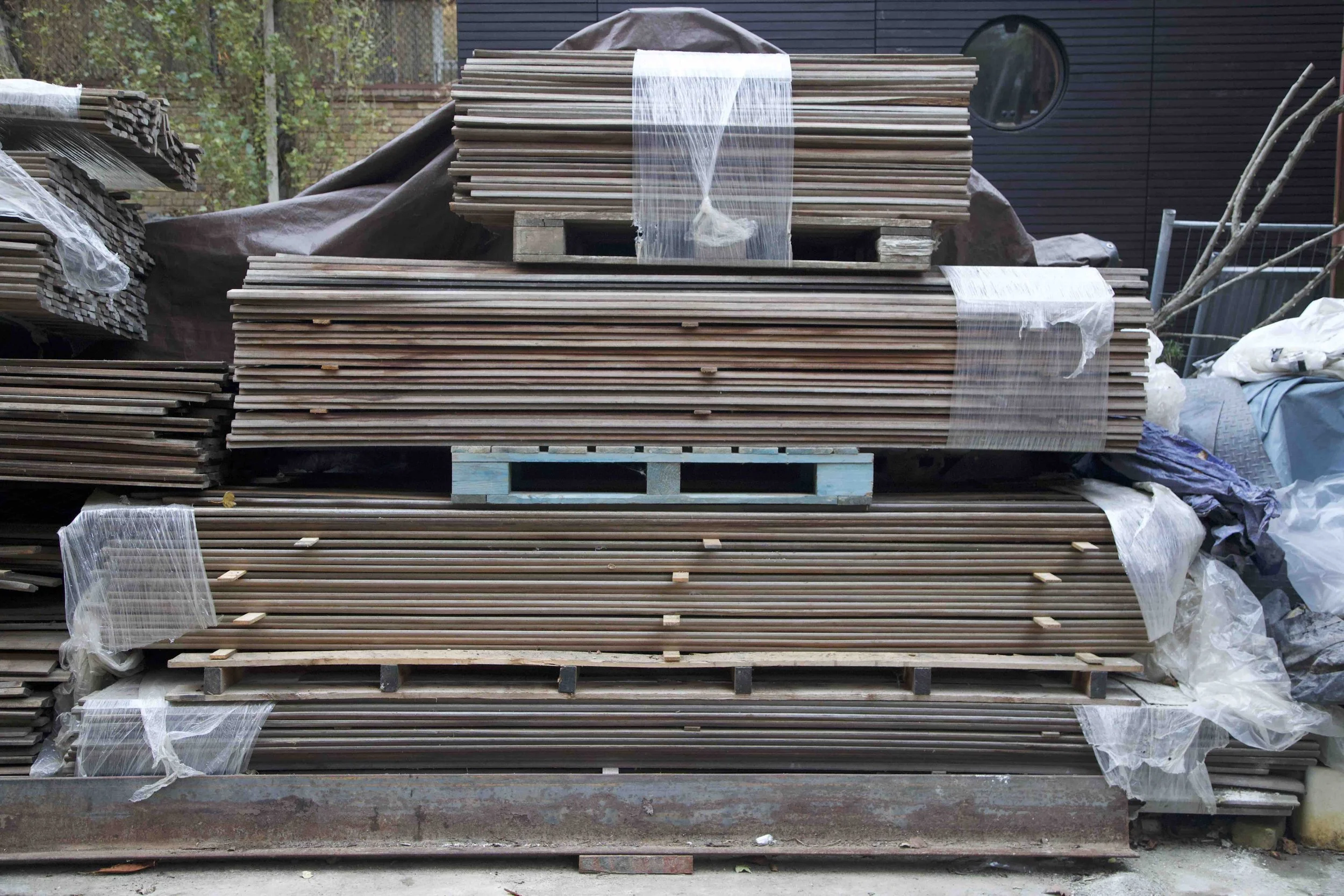
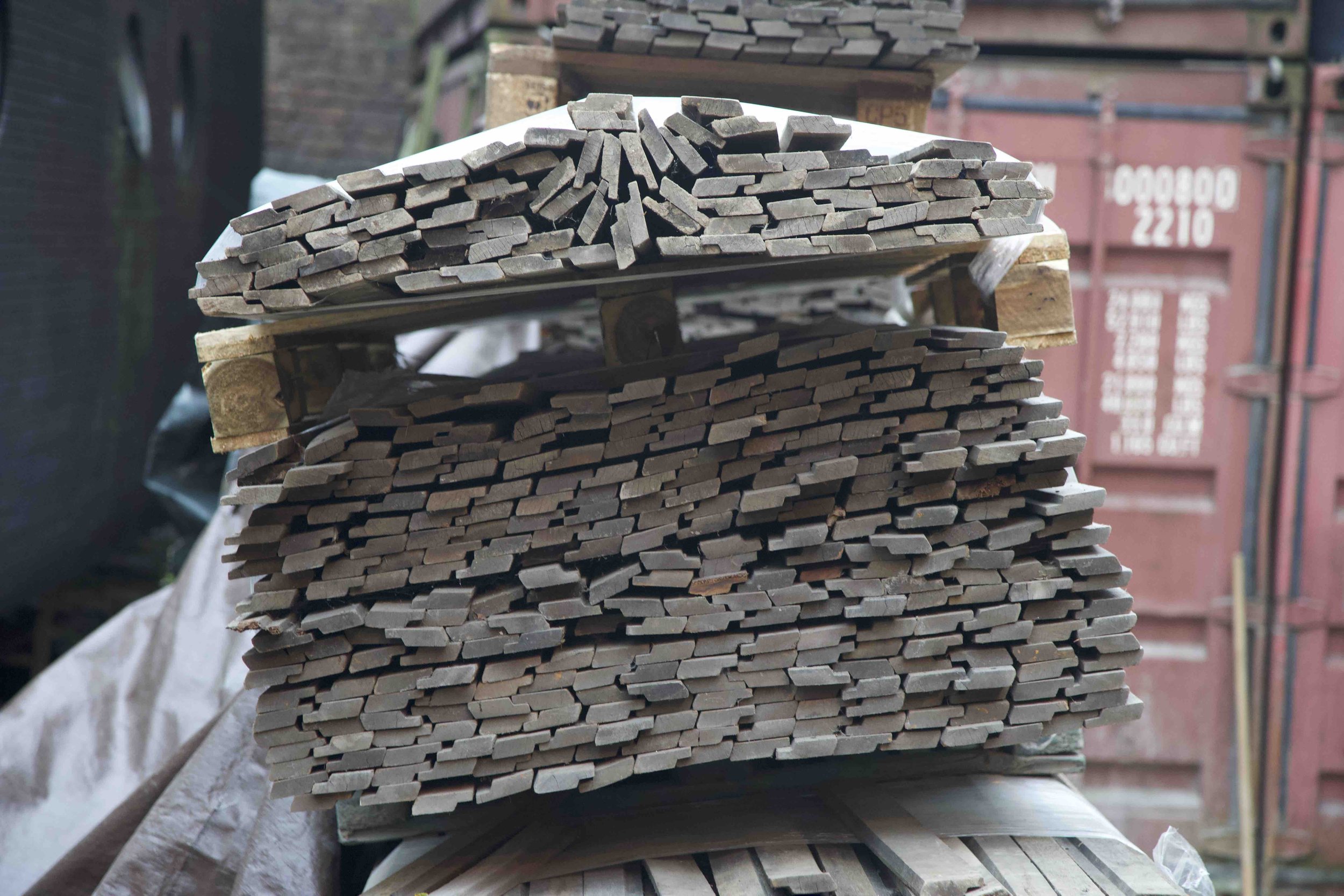
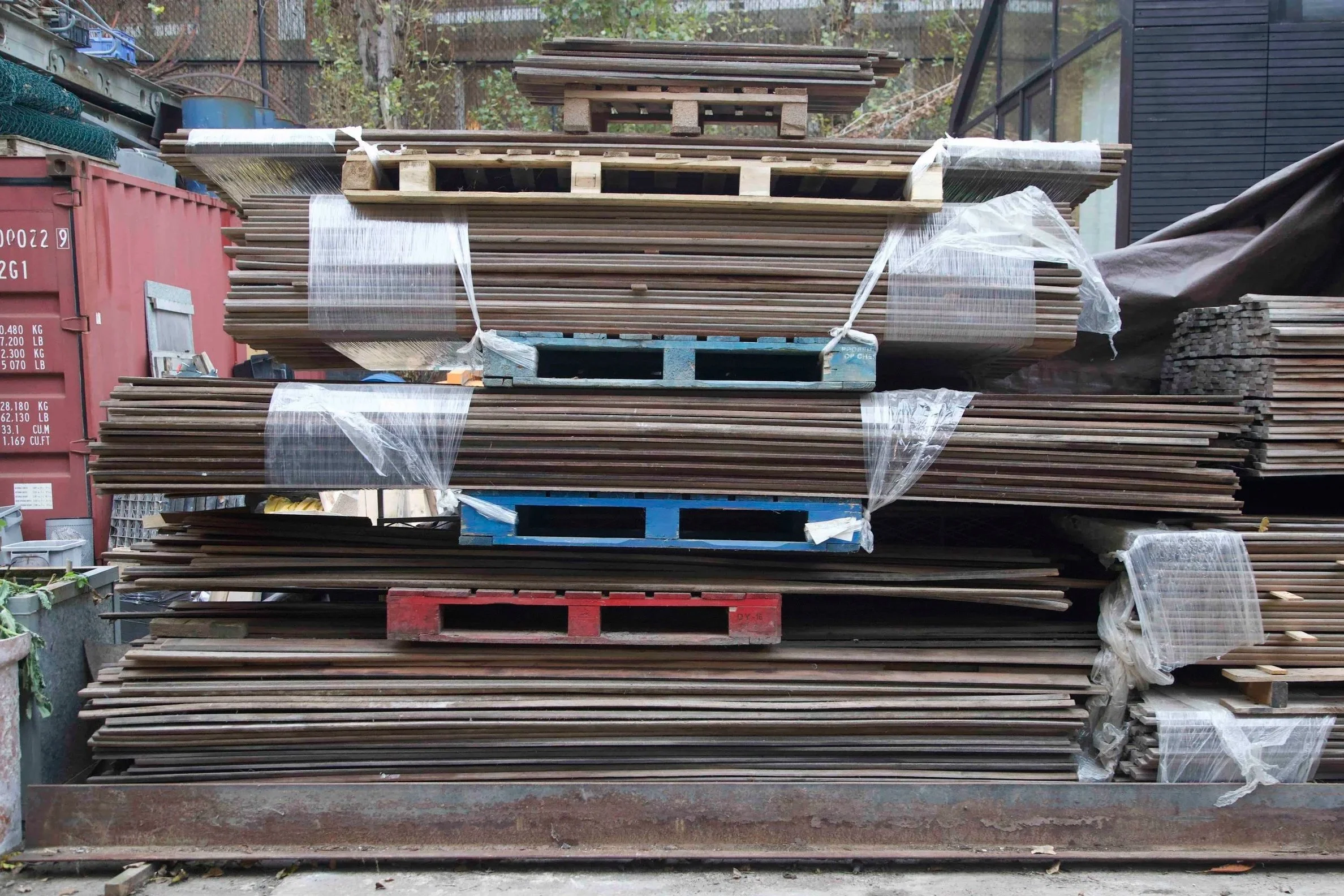
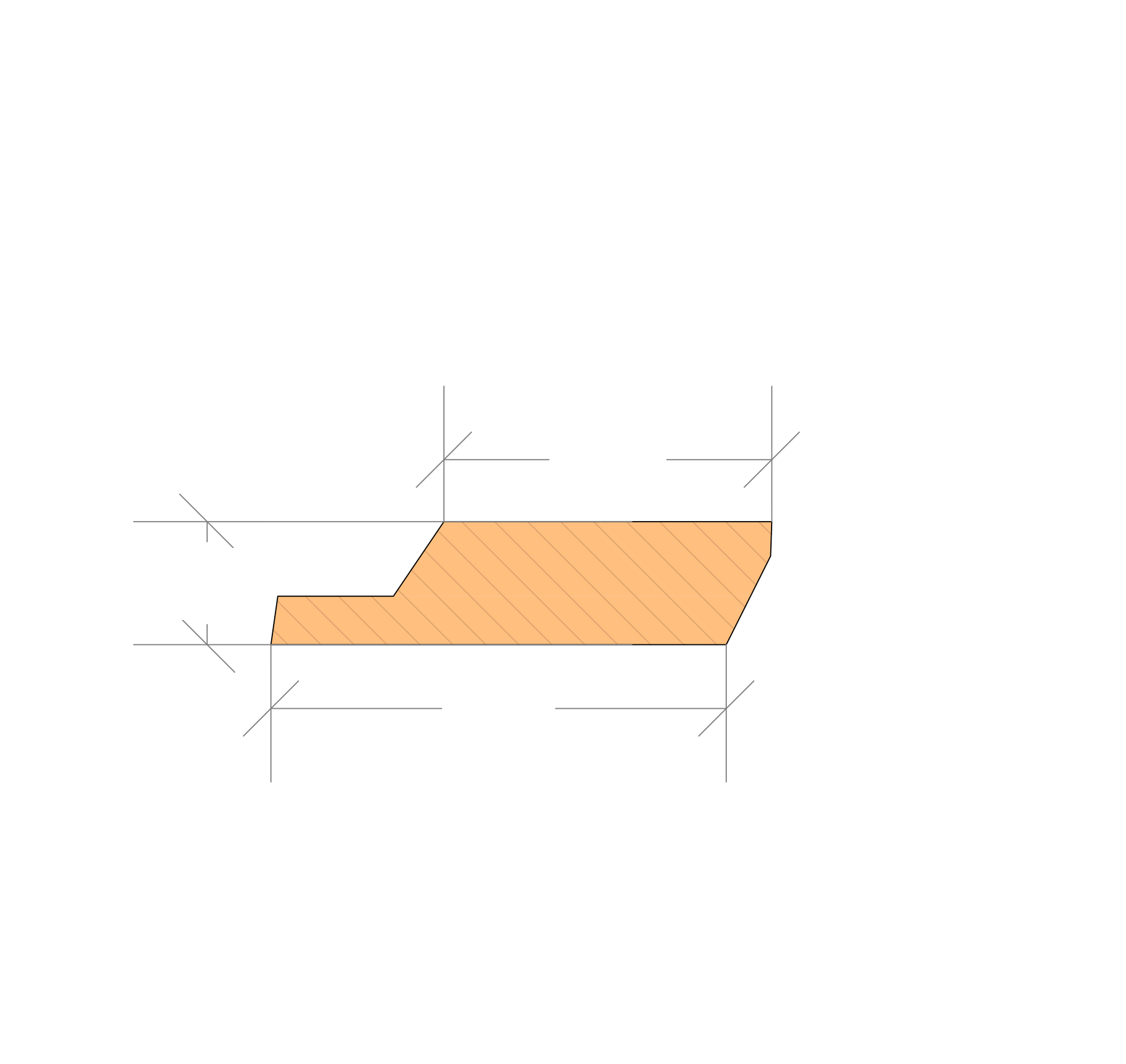
Red Louro
This attractive and durable timber lath material was reclaimed in very large quantities from a 2009 mainly-residential building in Southwark. The block fell victim of the Grenfell, flammable-cladding fiasco, culminating in the Grenfell Inquiry in which regulators, authorities, specifiers, suppliers and the fire brigade earned themselves a total of £175m blaming each other for the tragedy. A million people remain trapped in unsaleable flats that are deemed to be unsafe.
Estimated quantity: Over 5000 linear metres in various lengths.
Steel
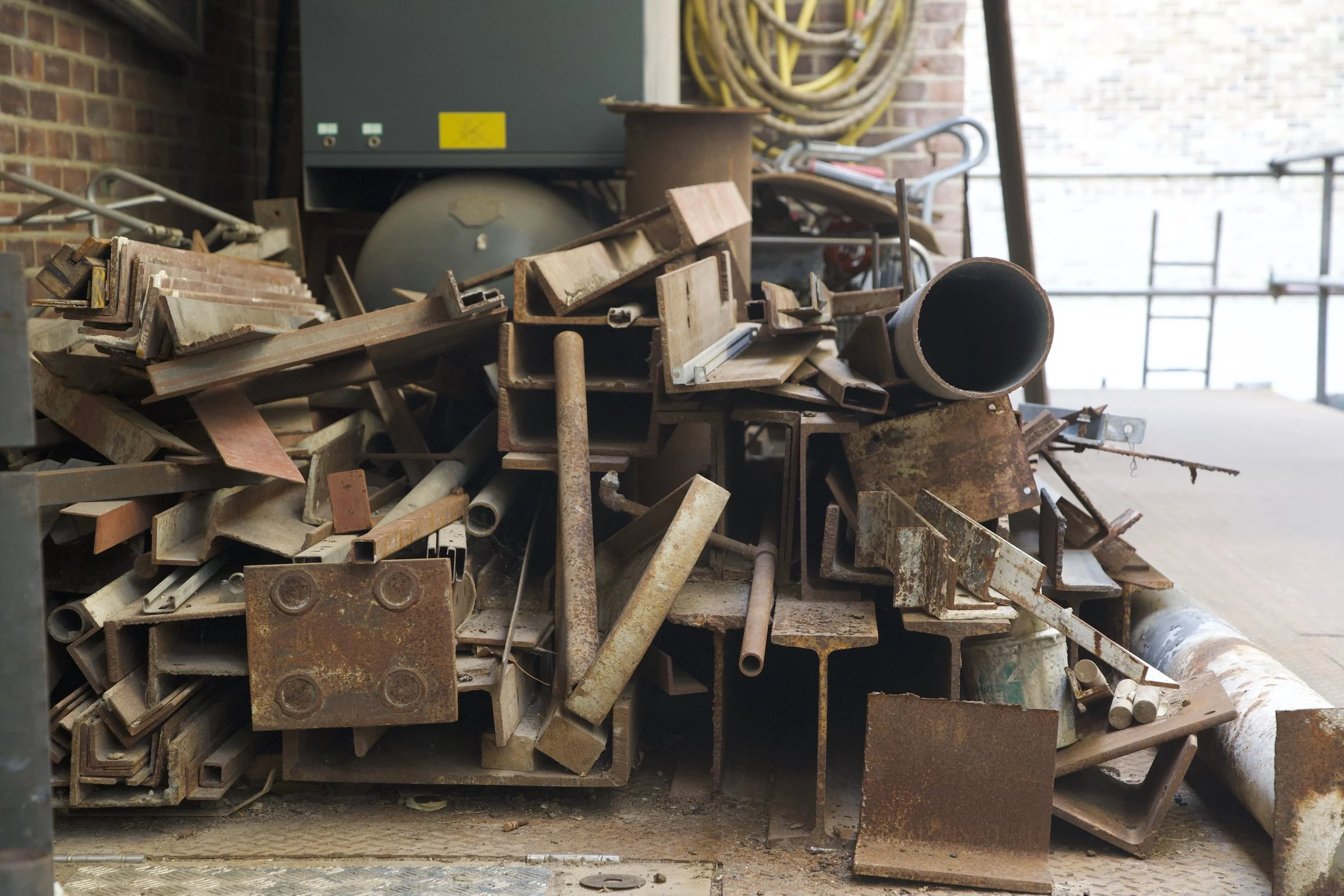
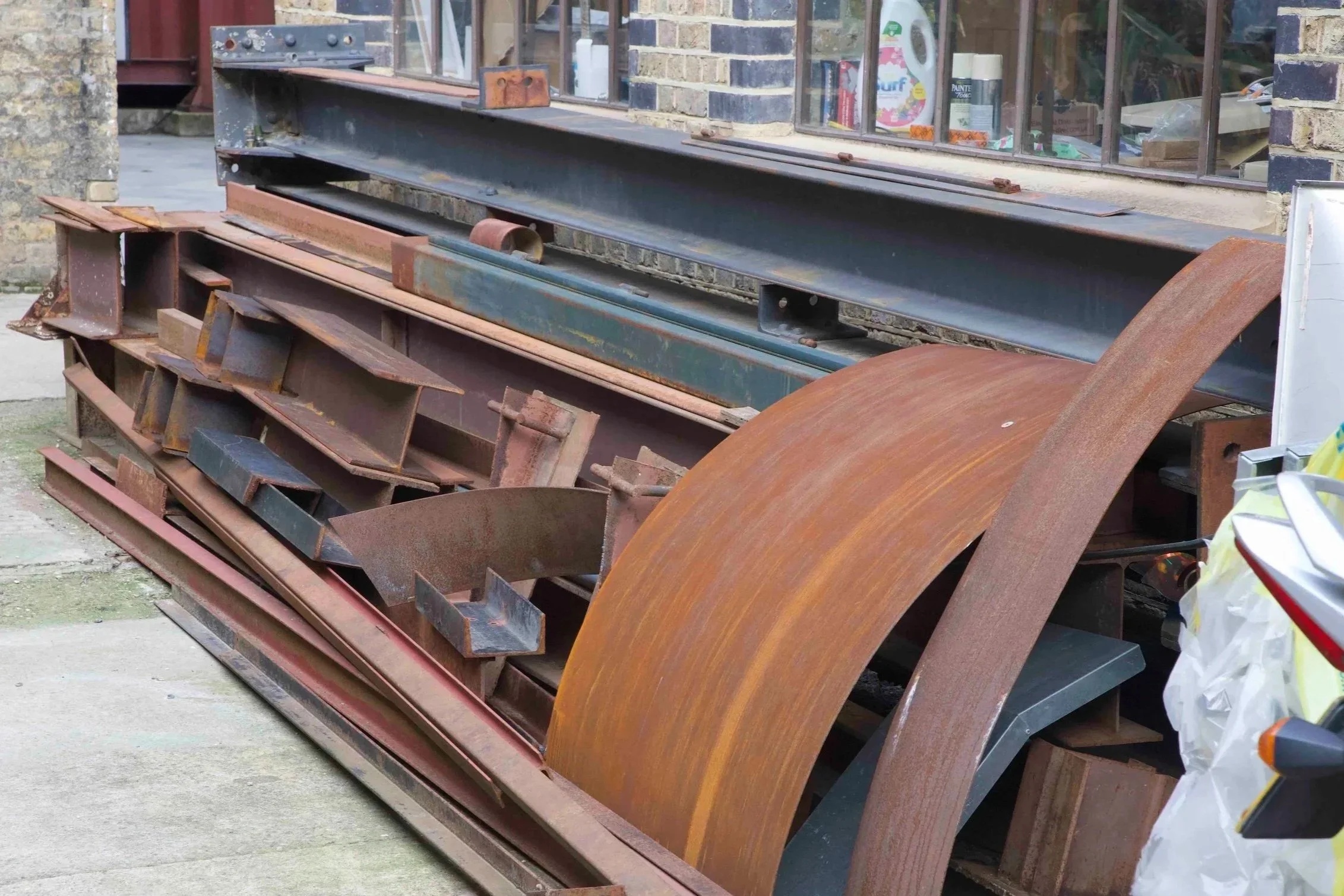
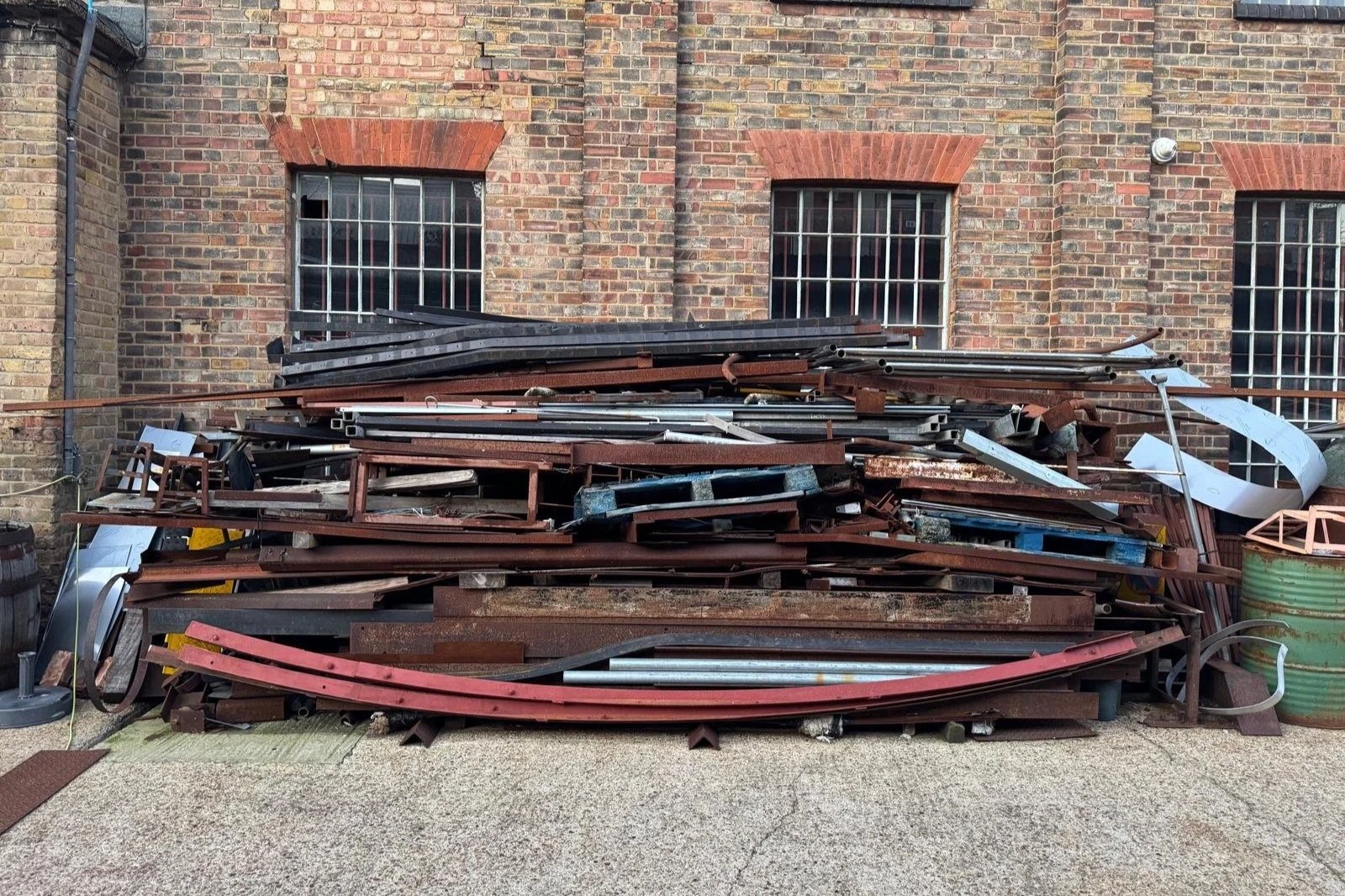
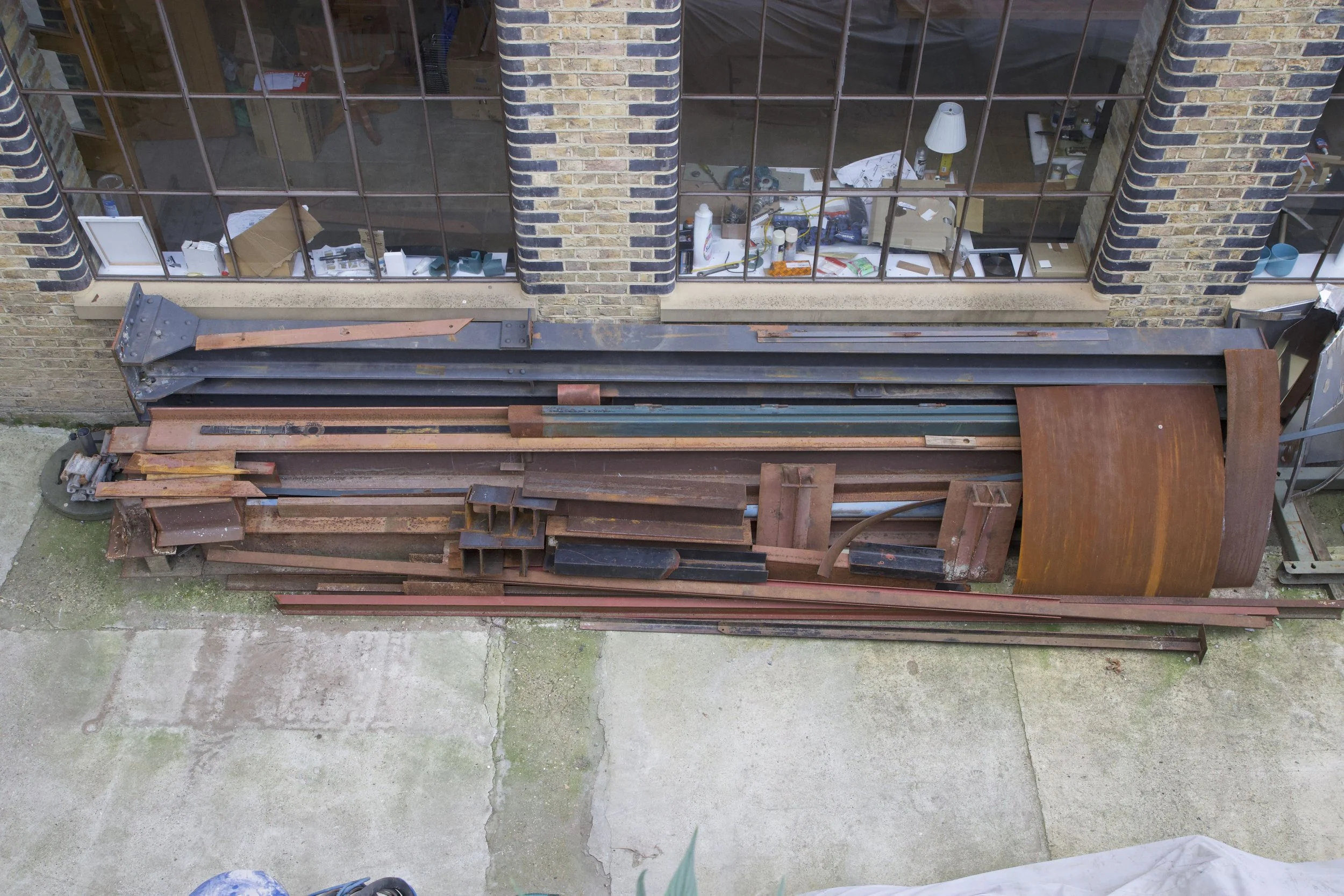
Scrap steels in varying lengths and sections, pictured, will be available for use in the winning installation, as well as lifting machinery to move and sort them. Basic metalworking tools such as angle grinders, saws and welding machines will also be available, however experience and skill working with steel is expected to make proper use of the material.
Masonry
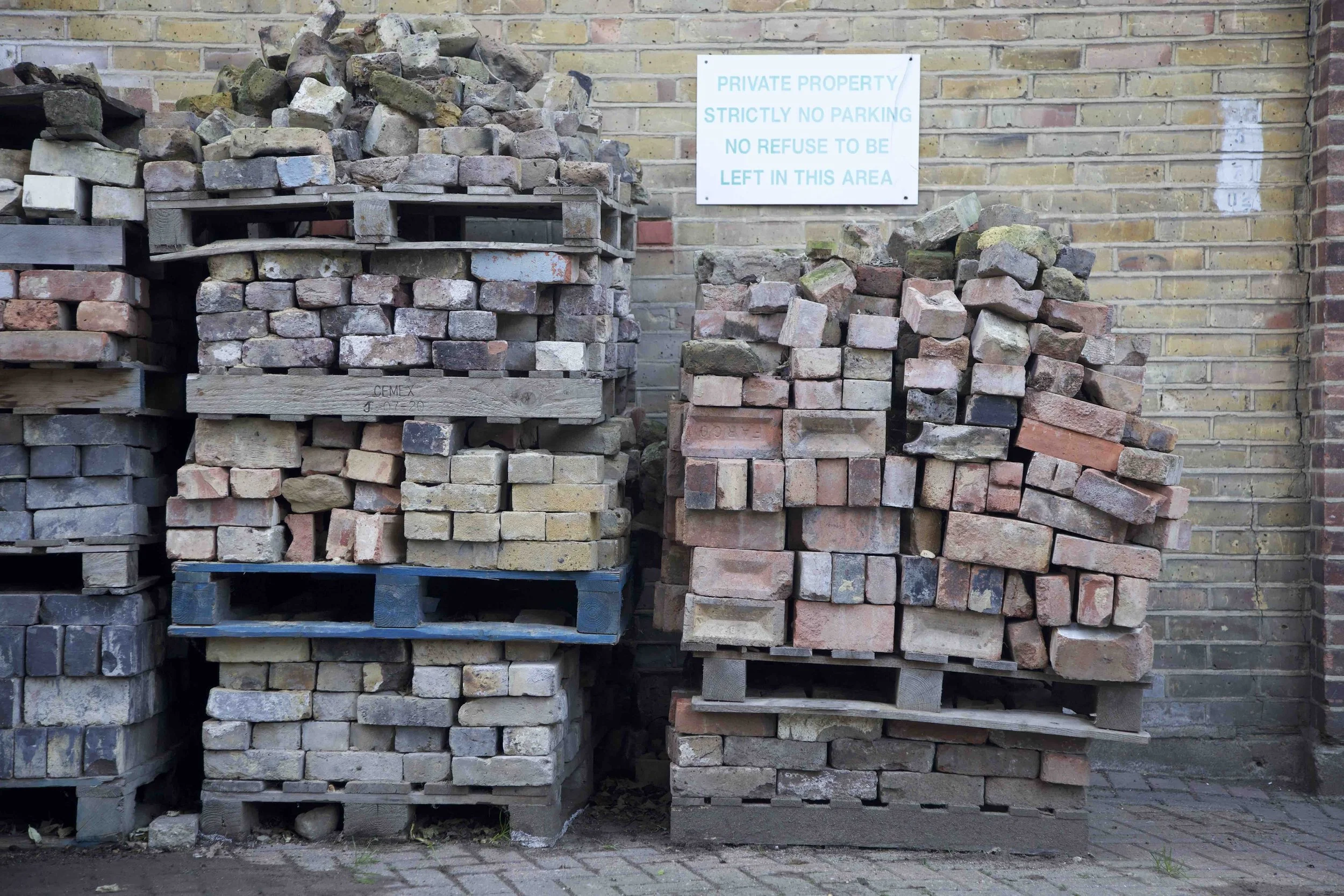
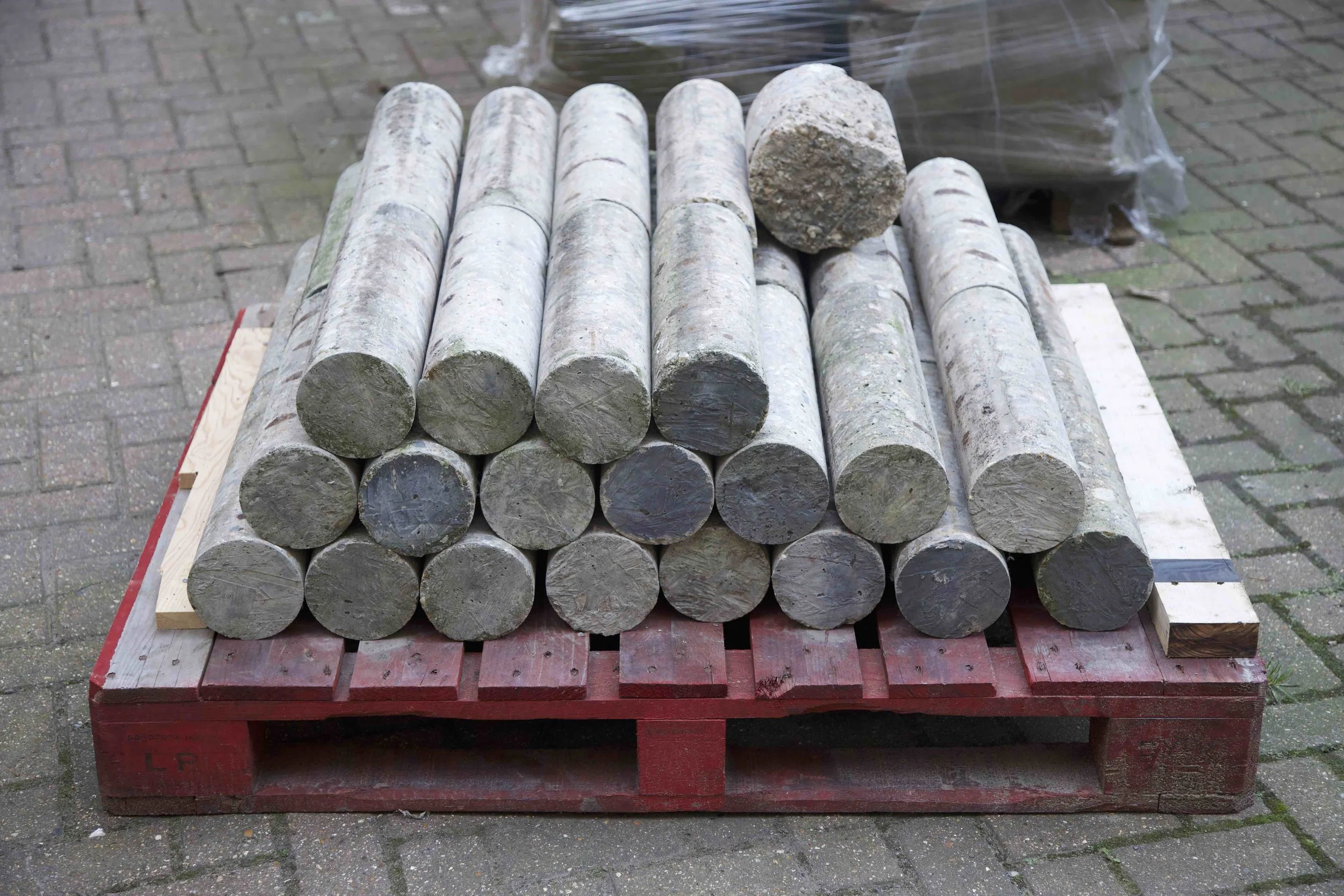
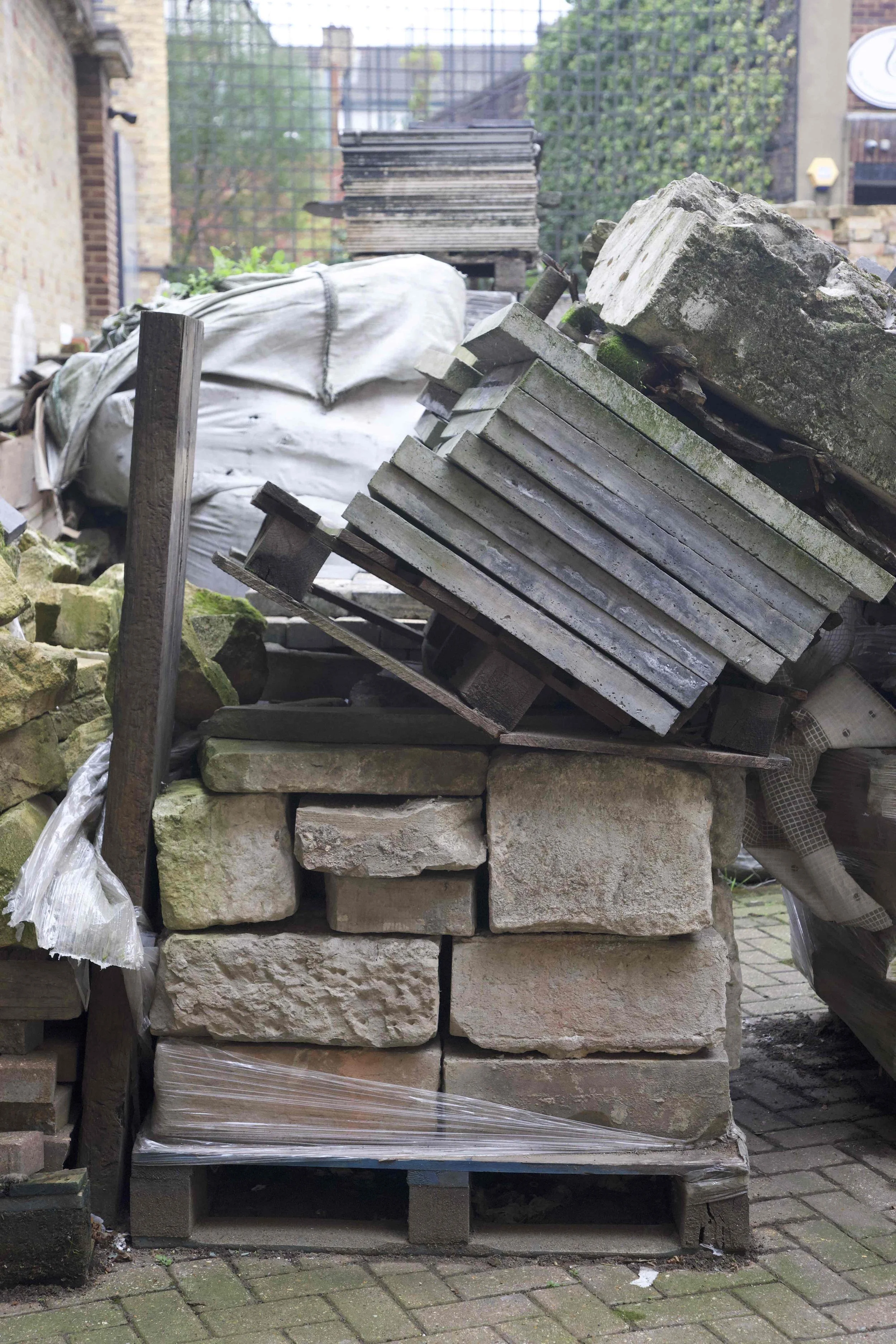
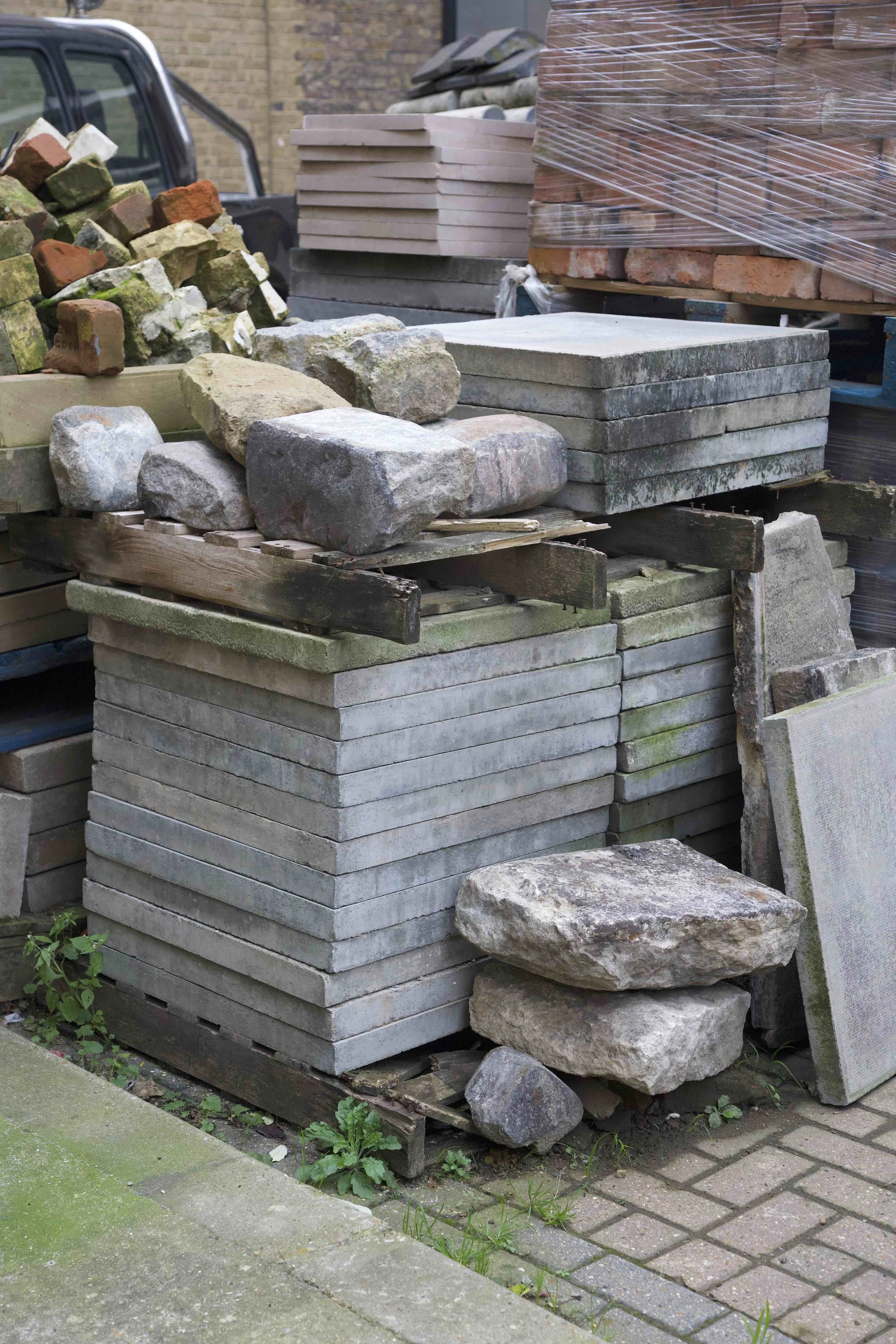
A quantity of reclaimed bricks (various), stones and composite masonry materials are also available (pictured below on pallets). They include paving stones, drilled concrete cores, pavoir bricks as well as typical stock bricks and flettons.
Glass and Window Frames
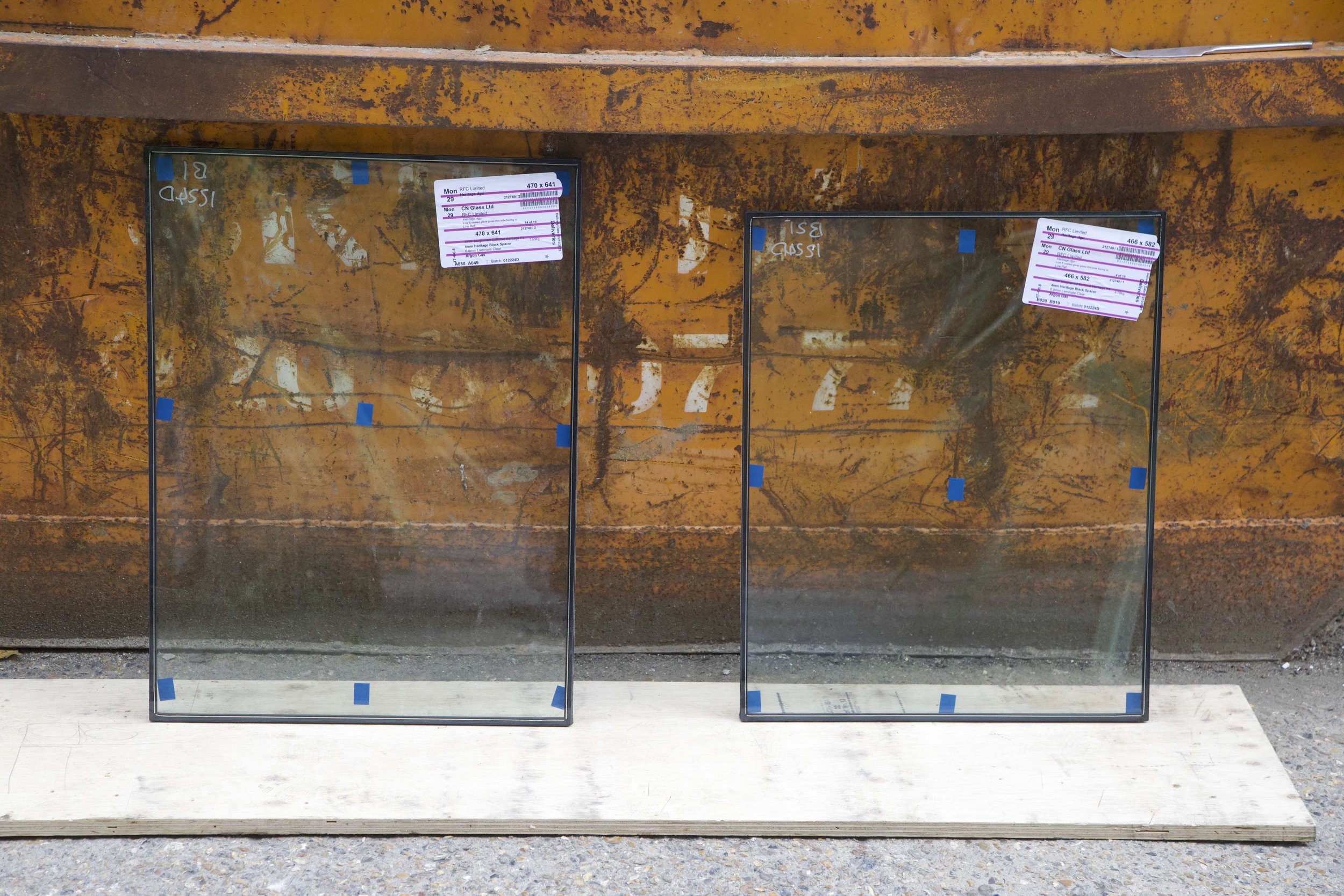
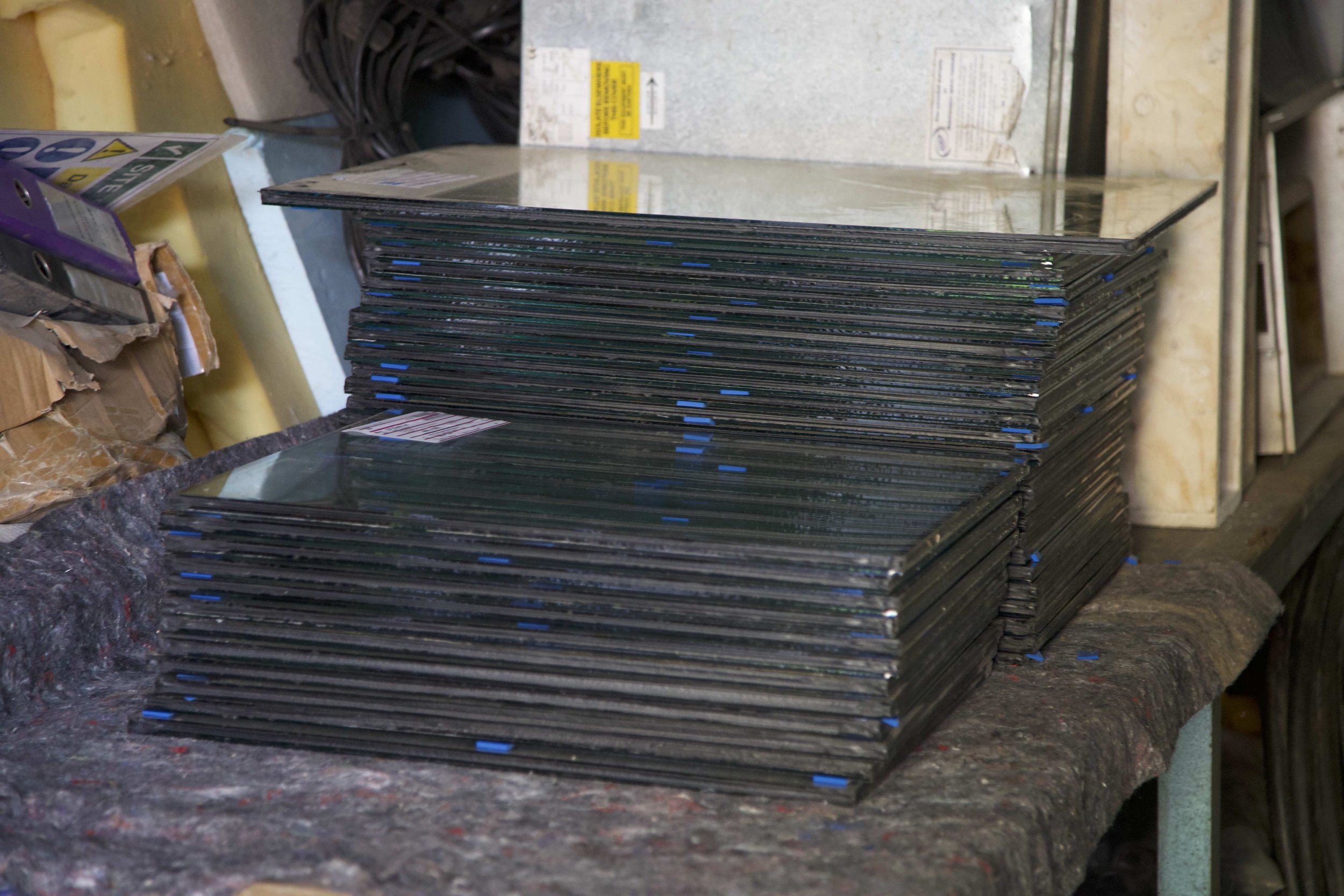
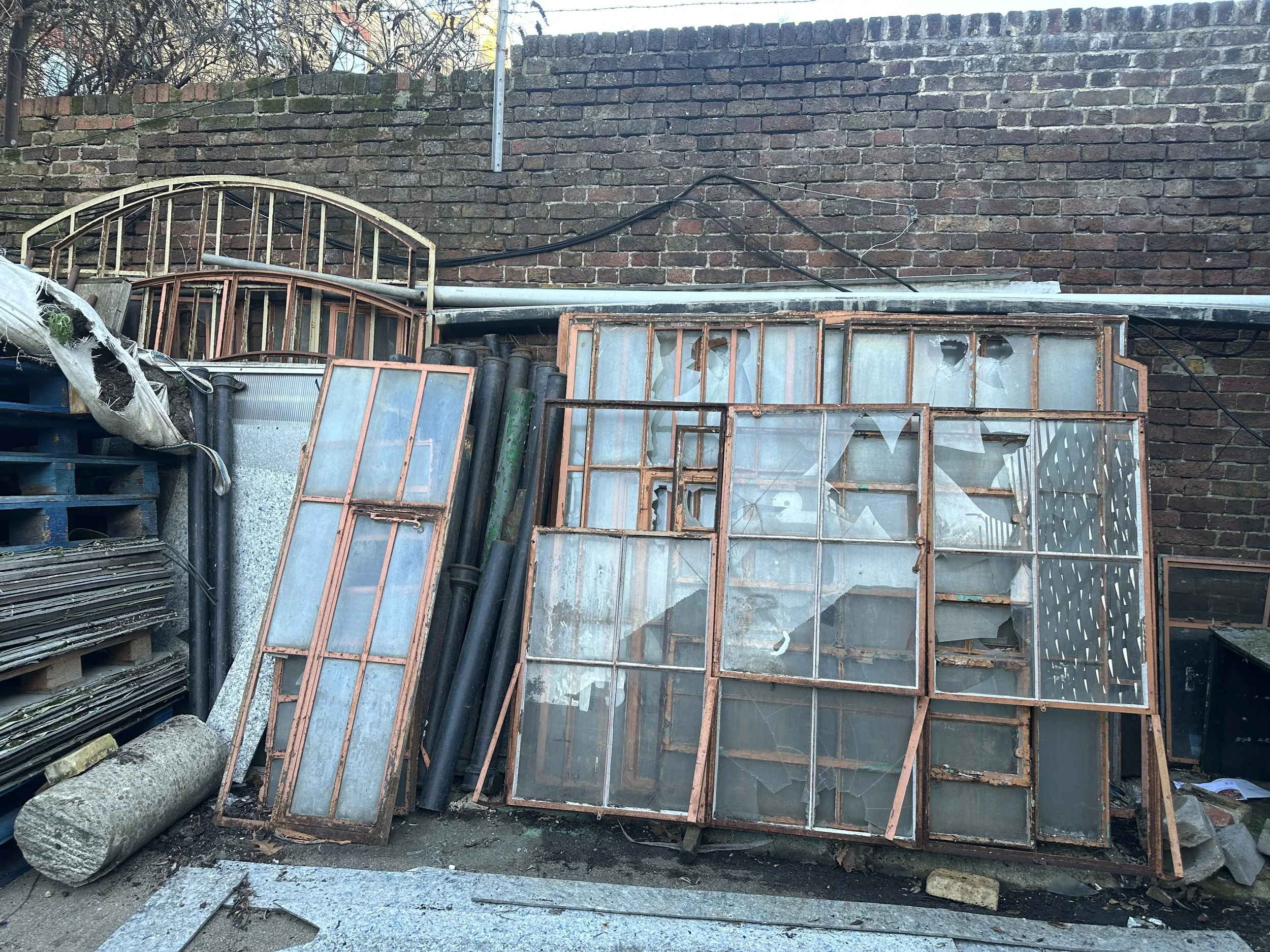
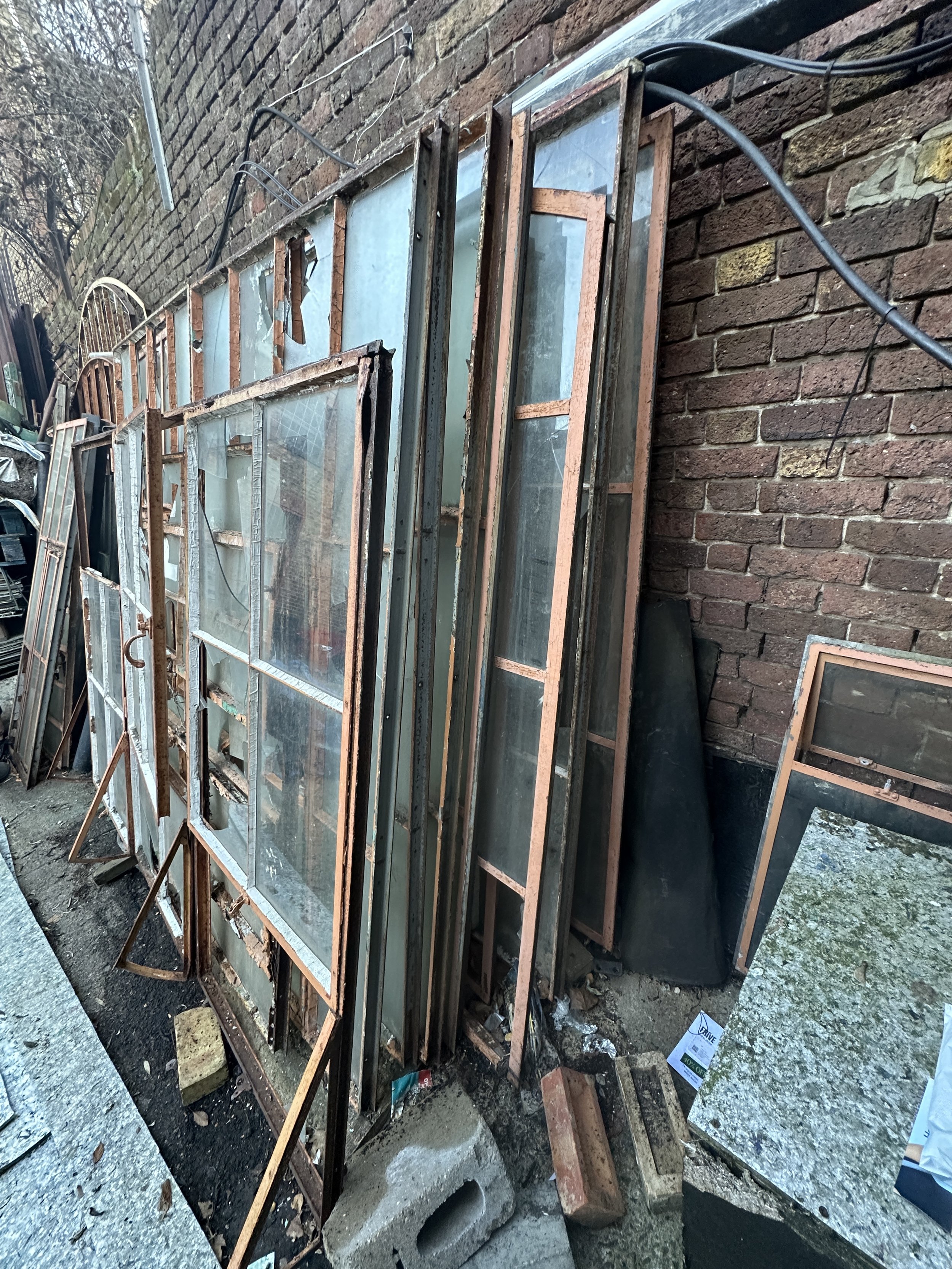
A total of 36 double-glazed units are available for reclaim. Twenty-four are roughly 470 mm by 640 mm and another 12 are 470 mm by 580 mm. The units are composed of 4mm toughened glass, a 4mm spacer, and 6.8 mm of acoustic laminate glass. They therefore have an overall thickness of around 15 mm. There is also an assortment of metal window frames of varying sizes and shapes available for use.
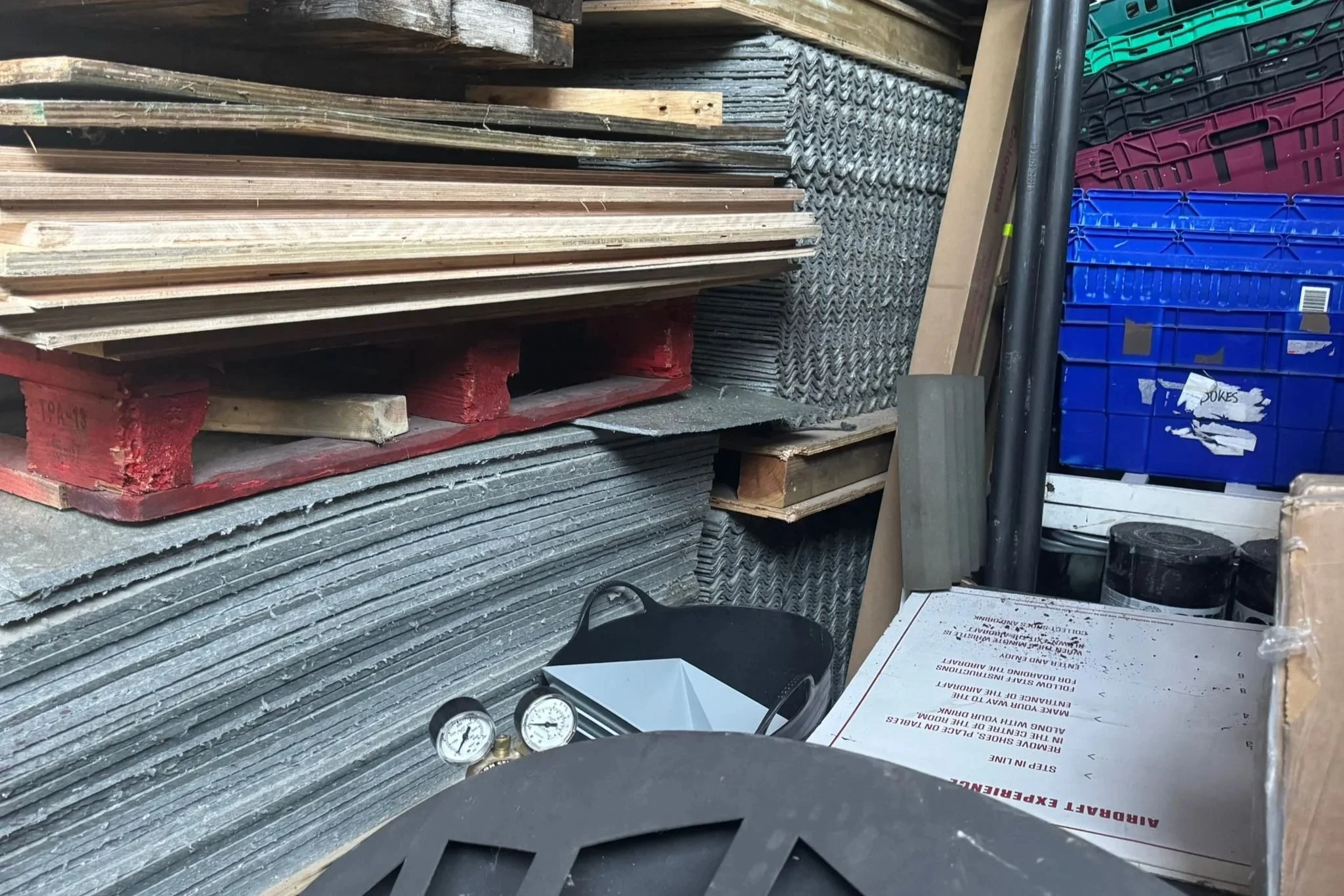
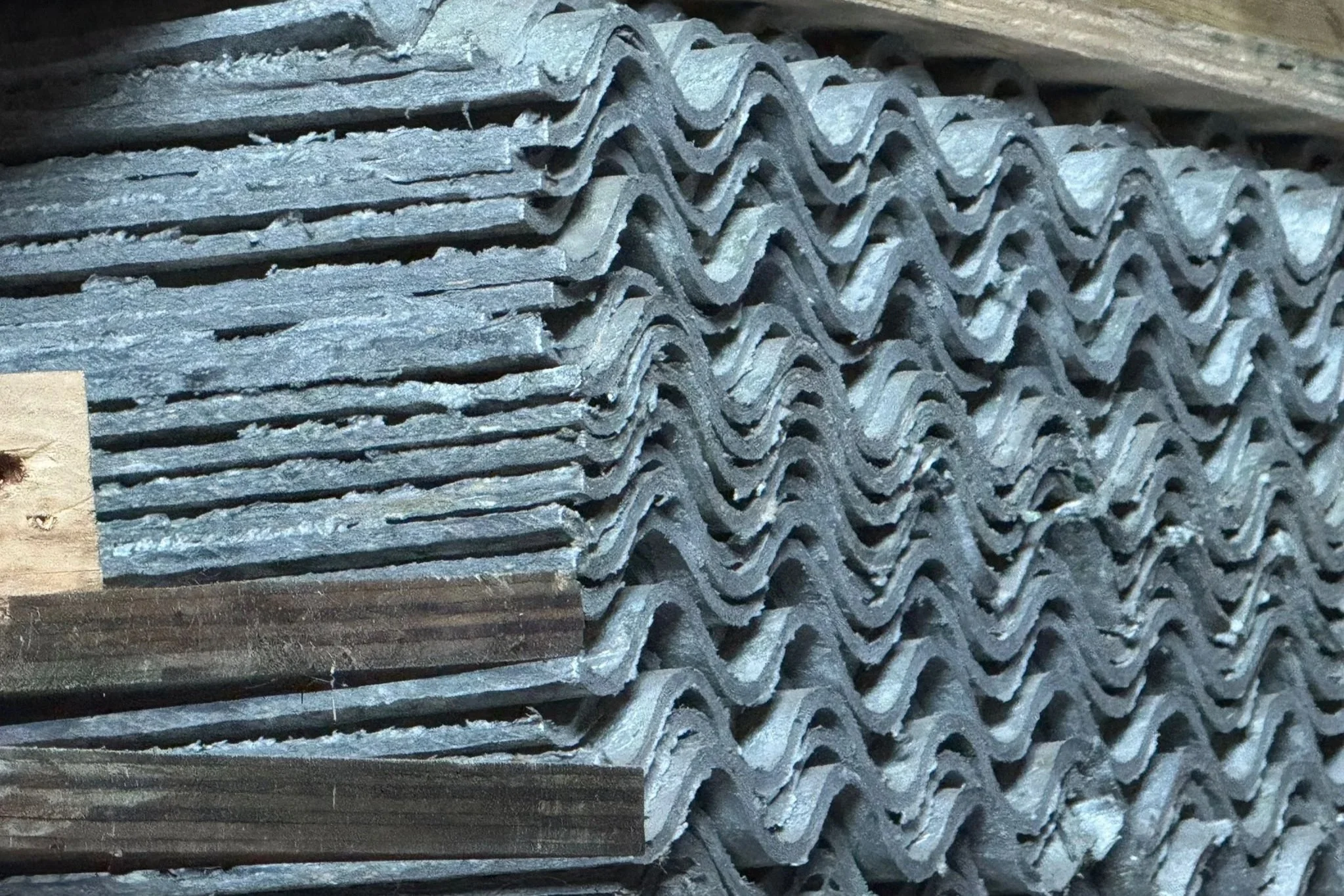
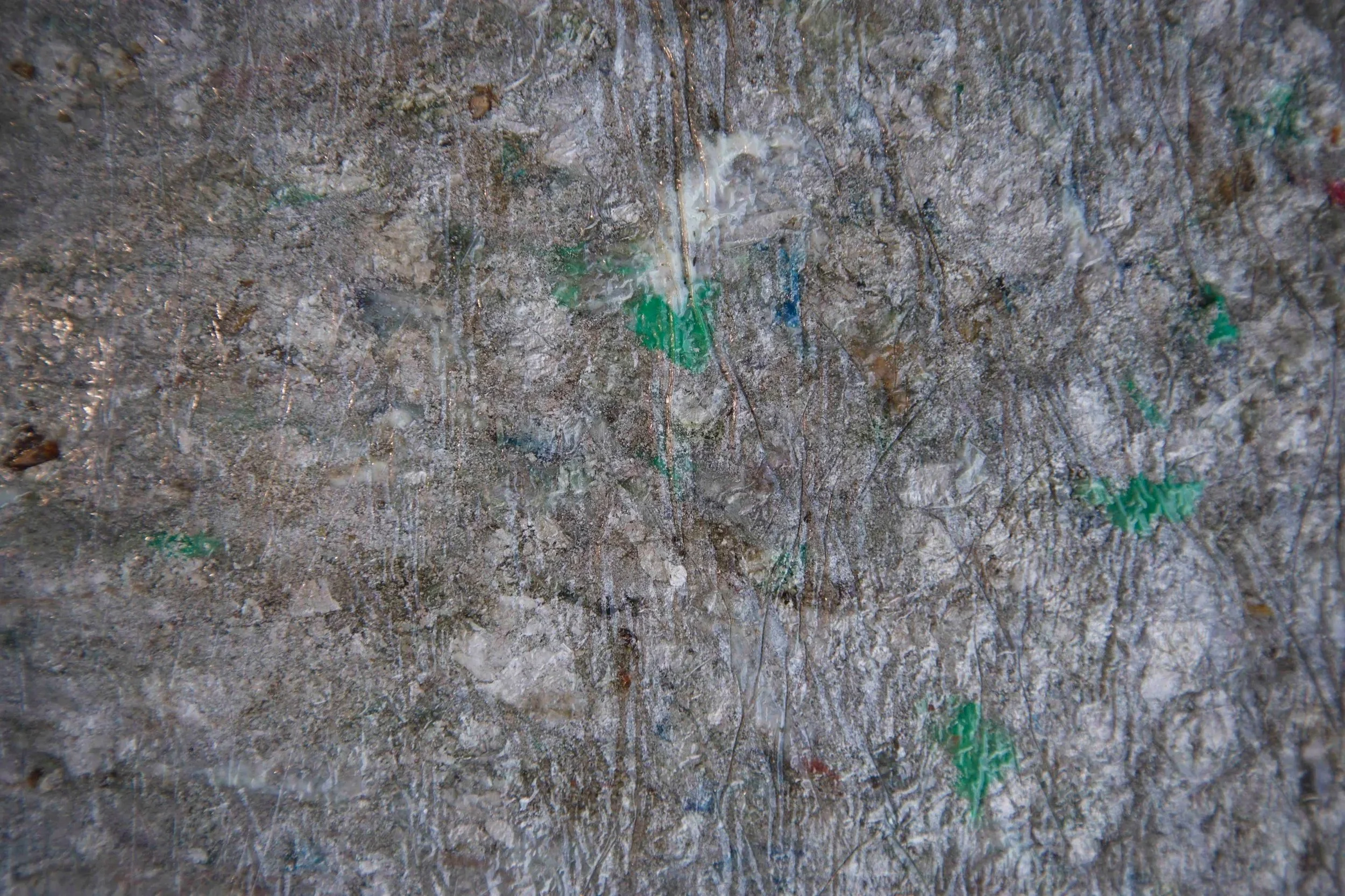
Recycled Tetra Pak Sheeting
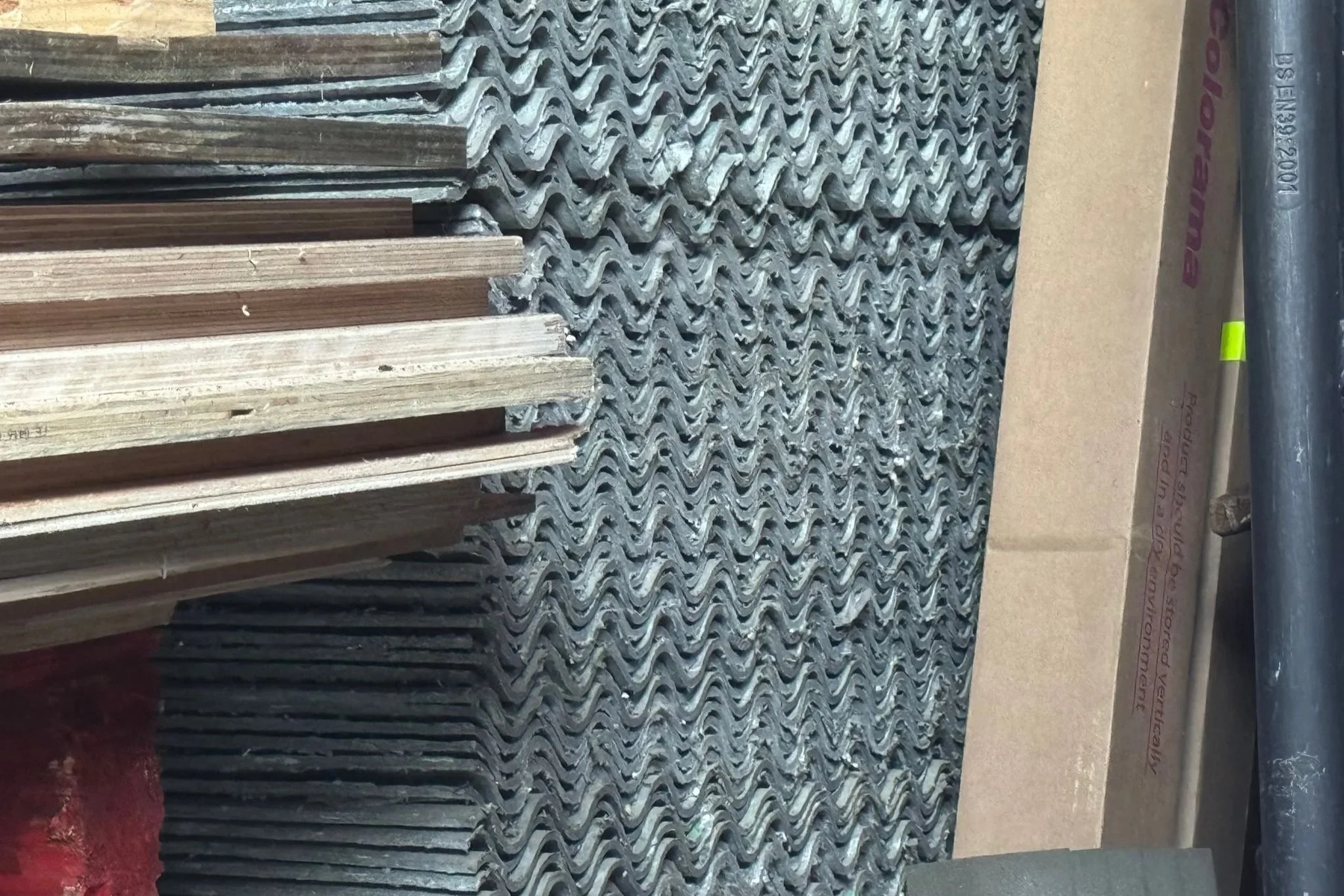
Plants in India and Vietnam have both produced this sheet material which is made by fusing together under heat the shredded polyurethane and aluminium foil sheets that are the otherwise unrecyclable layers of Tetra Pak cartons. The sheets come in flat (2.4 m x 1.2 m x 10 mm) and corrugated form (2 m x 1 m x 10 mm). They can be formed by manipulation when re-heated until they become plastic.
FOUND[ation]
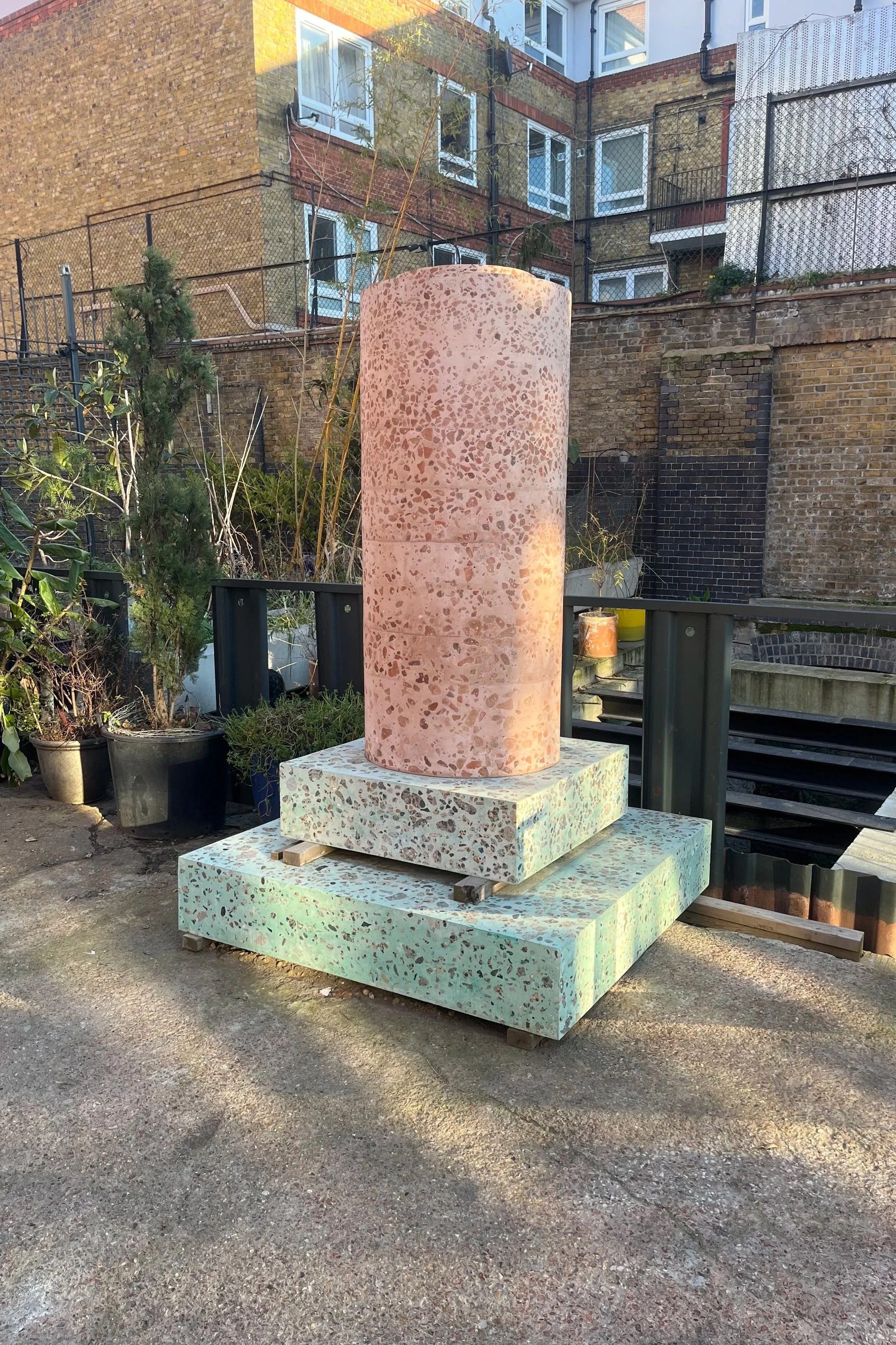
The 2024 Antepavilion, FOUND[ation], is also available for use. FOUND[ation], constructed from pink terrazzo, is a 1.5 m column sitting atop a 3 tiered base.

Locations
Drawings and pictures of the two sites can be found in the additional material (linked at the bottom of the page)
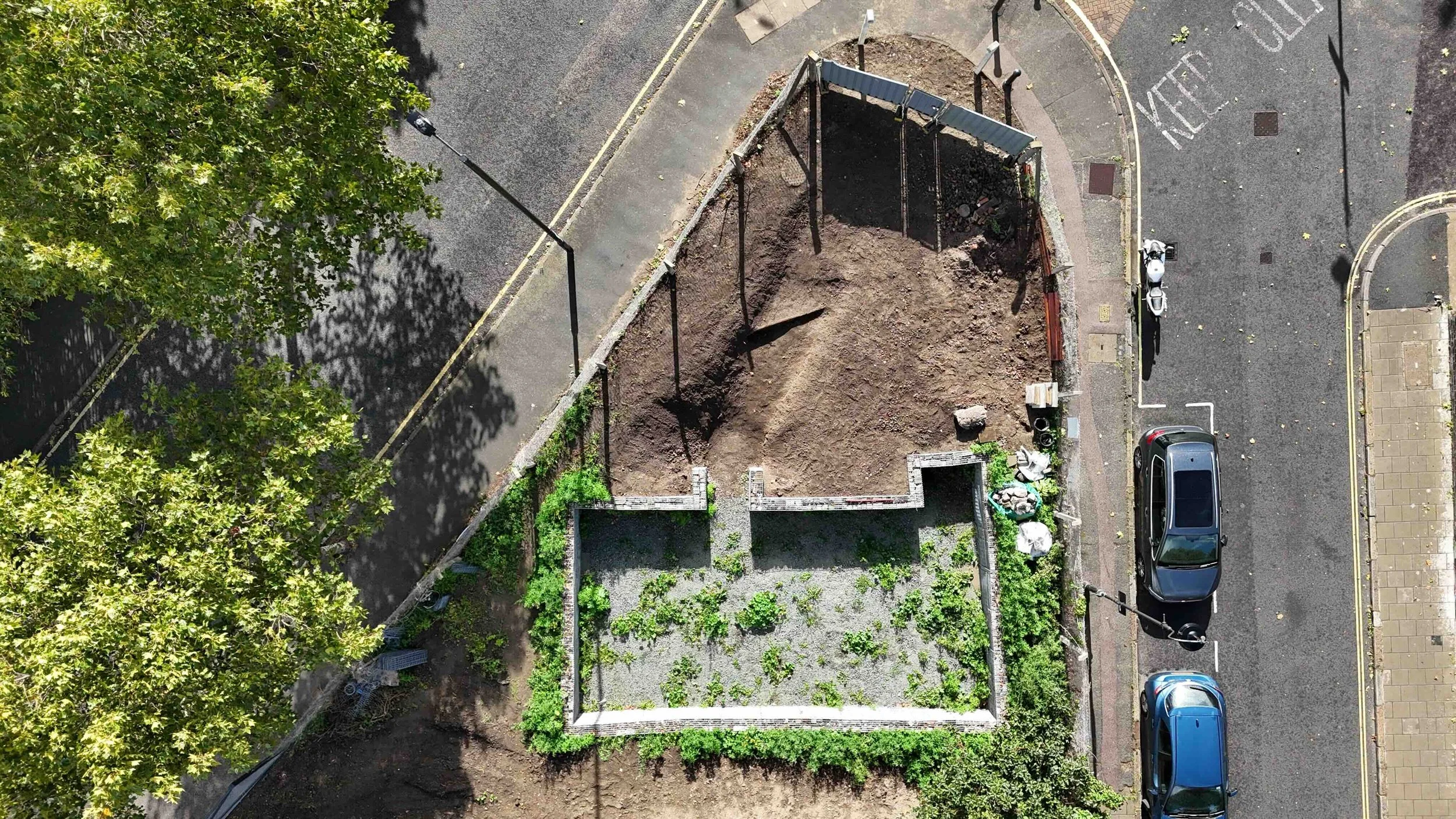
Pages Walk: Located 100m south-east of the Old Kent Rd flyover. The 0.03ha triangular site is bounded by Page’s Walk to the north-west and Mandela Way to the south. The site is nominally flat and the surrounding pavement level lies c. 2.5m above Ordnance Datum (OD).
It currently exhibits a 900mm deep recessed area demarcated by gabion basket walls filled with granite setts reclaimed from local street works. The recessed area represents the floor plate of a two bedroom flat on the notorious Aylesbury Estate which is located close by. Another workshop will form a lining occupying the area within the recess. Entrants are welcome to augment/complement/collaborate with this workshop if they wish. Sketches of the workshop are available in the resources.
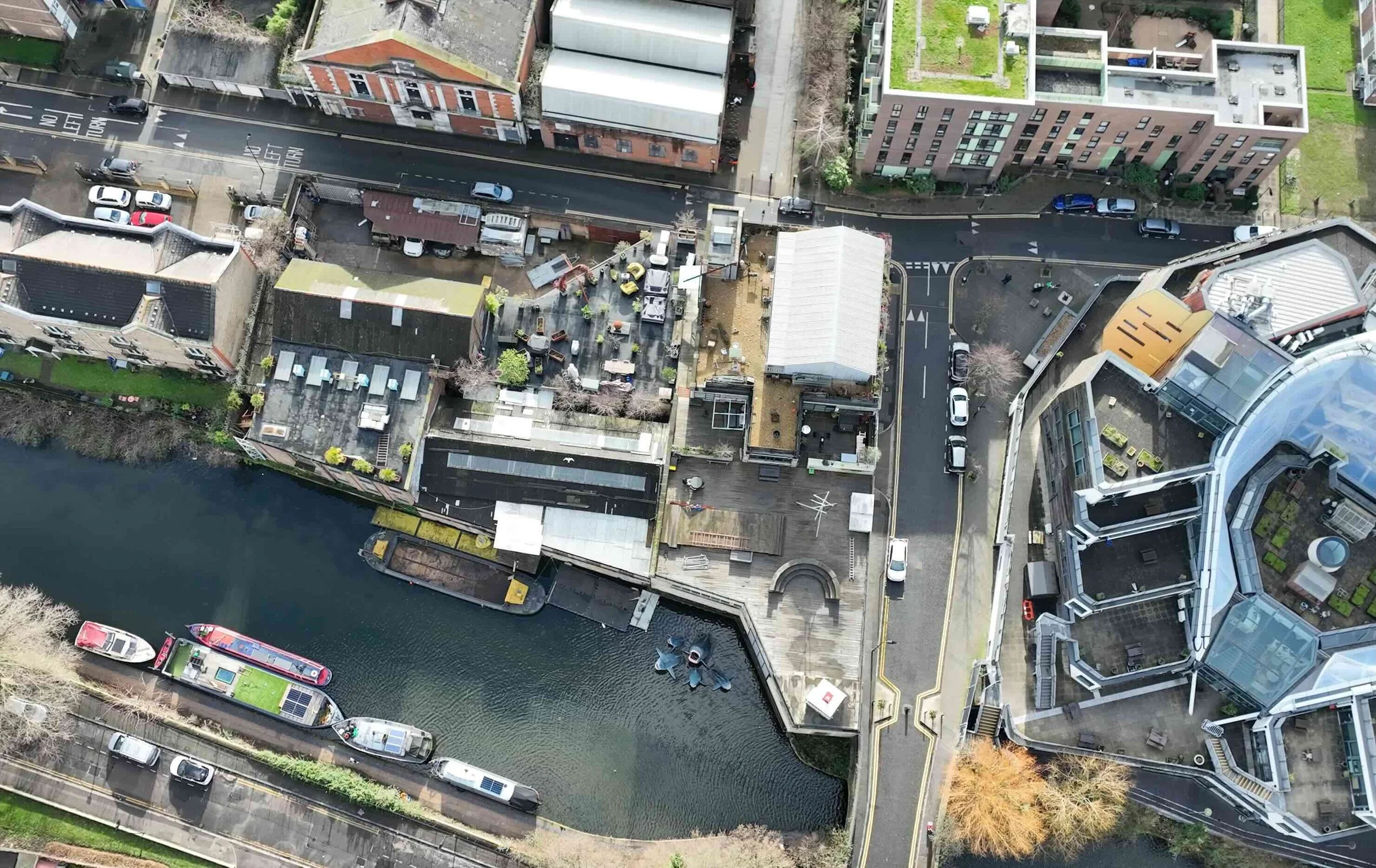
Hoxton Docks: Any of the buildings’ rooftops or walls, the pontoons in the canal and the barge, Ouse, are all available for display purposes. The pontoons are a system of connecting floats, each of 4.2m metres by 2.1m area. Ouse is 19m long, 4.5m wide and 1.5m deep and fitted with her own diesel engine.
Facilities
The winner of the competition, as usual, will have facilities at either Antepavilion’s Hackney site or its Southwark site for any construction work required for installation of the winning entry. Any lifting equipment necessary can be arranged and accommodated at the site.
It is to be noted that the Southwark site is currently hosting two Antepavilion workshops which place some limitations on how entrants proposing to use this site may do so. Details will be available at the open days and, when available, in the ‘resources’ section.
Re-use
Unlike in previous Antepavilion briefs where re-use of materials was strongly encouraged, for 2026 it is compulsory as no funds will be made available for the purchase of additional new materials.
We have acquired a large quantity of reclaimed Red Louro lath cladding that has been very expensively removed and replaced in one of the hundreds of cases of blocks of flats that were recognised to be a fire risk following Grenfell. Most of these materials will be presented to entrants at the open days and many can be seen in the resources file.
Budget and Prize
Because of the restriction of the entrants to re-use of materials already available there will be no budget for new primary materials. Up to £5,000 will be available to the winners for ancillary materials (fixings, adhesives, cement, etc), tools, other recycled materials, specialist skilled labour costs (if entrants can’t bring such skills of their own – which is of course much preferred) or any other specific purchase necessary for the work to realise its full potential that cannot be produced by the entrants themselves.
The usual £10,000 prize money is unchanged from all previous years. (Including being subject to deduction for any overspend required to complete the project.)
Again as in the past the winning team will have access to machinery and craftsmen on site and at nearby commercial workshops, as well as support from a structural engineer.
Timetable
Closing date for entries is midnight on Friday 27 March.
Shortlisted entrants will be notified by Tuesday 7 April and invited to present their proposal in greater detail to the judges on Thursday 23 April.
Winners will be notified on Friday 24 April.
Installation is to be completed in June or July.
Opening event for the 2026 Antepavilion will be 1 August.
Process and Selection
So we can update you on resources and open days please register your interest.
Entries to the Antepavilion competition should be submitted digitally using the online entryform. There is an administrative fee of £20 to submit an entry.
Each entry should comprise a proposal title, team or individual name and two A3 boards showing the proposed work formatted as a single PDF document. The PDF should be named in the following format:
[name of proposal]_[name of Individual/practice/artist].pdf
Ensure the pdf is flattened and each page sized A3 for printing.
The boards themselves must be anonymous. Please do not include the names or contact details of you or your team in the PDF, only as the file name and in the entry form.
Entries will be considered by a cross-disciplinary jury to be announced when appointed. The jury will include the winner of the previous Antepavilion Competition: Moonument. About five entries will be chosen for further development. A small bursary of £500 will be given to the shortlisted applicants to fund development of their final presentation. Structural engineering support will also be available to develop the shortlisted proposals at this stage if required.
All entries will be displayed at the opening party on 1 August
Open Days
Potential entrants are invited to view the sites and materials listed above on one of four open days. Both sites will be open to visit on these days:
Sunday 1 February, 11am - 3pm
Saturday 14 February, 1pm - 4pm
Sunday 1 March, 11am – 3pm
Saturday 14 March, 1pm - 4 pm
(Please email (admin@antepavilion.org) for specific information)
There is no need to book an attendance at open days but registering an interest in the competition is recommended so that those planning to enter can be circulated with updates.
Questions from entrants
Questions from entrants may be emailed to admin@antepavilion.org. Answers will be posted openly on the FAQ page.
Further Reading
A resource pack with specifications, drawings, photos, and materials is below.
A further useful resource for this year’s Antepavilion is ‘Architecture and Anarchism’ by Paul Dobraszczyk. Published by Antepavilion and Paul Holberton, the book discusses many examples of structures self-built from reclaimed materials.